
5 Financial Terms Everyone Should Know (So You Can Finally Feel in Control of Your Money)

What do you think when you hear the word finance? Perhaps you imagine a Wall Street guy screaming on some exchange floor, complicated math, or a very boring meeting. You’re not wrong to think of these examples, but finance simply refers to the management of money.
So, if you use money to buy food, pay rent or a mortgage, or cover other everyday expenses, it helps you to learn some basics of personal finance. Knowing these basics can reduce money-related anxiety and give you a greater sense of control.
In the next sections, we’ll break down five financial terms that can help you stay ahead with your finances: Inflation, Risk, Time Value of Money, Interest Rates, and Compound Interest. You’ve probably heard most of them, but do you really know their meaning and how they affect your life? Do you know how they relate to one another?
1. Inflation: The Silent Pay Cut
In the last couple of years, we all got more than familiar with inflation. After the pandemic, prices surged, and suddenly, your paycheck didn’t allow you to purchase what you were used to.

So, what is inflation?
Simply put, inflation is the general increase in prices in the economy. It is usually measured based on a determined basket of goods and services, and economists evaluate how much it increased or decreased from one period to another.
Some inflation is good. As a matter of fact, the central bank of most countries sets an inflation rate target, which in the US is 2%.
The problem arises when inflation is too low, negative, or — as we are seeing — too high. Which is exactly what happened in 2022, when inflation started to increase, reaching 8%. While today, in 2025, inflation has been on a downward trend, it is still above the target.
NerdWallet has an excellent post explaining inflation.
Why does it matter to you?
Inflation matters to you for several reasons:
- If your income doesn’t increase at the same rate as inflation, your lifestyle will be affected, since you won’t be able to purchase the same amount or quality of goods and services as you could before.
Imagine you normally spend $1,000 on groceries each month. First, you might notice prices are slightly higher, maybe $1,005. Over the months, costs continue to rise to $1,080, $1,090, or even $1,100, as happened in 2022
The problem is that prices rarely go down, so even if inflation starts to normalize, we are all stuck with the new price levels.
- Your savings lose value over time: Since prices are increasing from one year to another, you won’t be able to purchase in the future what you can purchase today with the same amount of money. This means that if you have savings, your savings will lose value over time. To prevent your savings from losing value, you need to invest them depending on when you plan to use them — this could be in a high-yield savings account, stocks, bonds, etc.
What can you do about it?
- Get familiar with the concept of inflation, which you are doing by reading this post.
- Get acquainted with inflation in your country. You don’t need to become an expert, but try to figure out the answer to these 3 questions: Is there an inflation target? What is the current inflation rate? Is inflation expected to go up or down?
- Organize your finances: budget, build an emergency fund, save, and invest. You can read the MML article on budgeting here.
- Avoid lifestyle inflation. You can’t control inflation, but you can control your money. Learn how to avoid lifestyle inflation here.
- Increase your income: We know this is easier said than done, so this is a medium- to long-term move. But make sure you negotiate salary increases, take on a side hustle if you need to, and keep upgrading your skills.
- Watch your expenses: If money feels tight, like in the grocery trip example, try to be flexible, change brands, find cheaper stores, and find creative ways to save. Read this post for some ideas.
- Make sure your money is growing, whether it is in a savings account or invested.
2. Risk — The Cost of Uncertainty
Do you associate risk with something good or something bad?

We often associate risk with something bad, but in reality, the risk we take can have both positive or negative consequences, since risk just refers to how much the result could vary from what you expect.
The Corporate Finance Institute actually defines it as:
“The probability that actual results will differ from expected results.” (CFI)
Imagine you buy Apple’s stock and expect it to go up by 10% over the next year. Your risk is actually that the actual return of Apple is above or below that 10%.
But this definition doesn’t apply just to finances; it applies to all aspects of life.
From everyday life, like visiting a new restaurant and taking the risk of it being better or worse than expected, to key life decisions like marrying someone who can be the perfect companion or a mismatch.
In business, if you’re a freelancer and you depend on just one client, your expectation is keeping that client; your risk is losing it. Other business-related risks can relate to giving time for your clients to pay you, getting too much debt, or depending on one key person.
Two important takeaways about risk:
- Risk can’t be avoided if you want the reward that comes with it, but it can be managed and mitigated. In the restaurant example we mentioned previously, the reward you’re seeking is that you want a delicious meal. The risk is that it can be a really good or bad experience. The way to manage it is to do some research before going there, like checking Google, Yelp, or asking a friend for recommendations.
- When you’re willing to take more risk, you’re most likely expecting a bigger reward. While this may not apply to everyone, especially daredevils who love risk for its own sake, it is true for most of us and is a key principle in finance.
Imagine you can invest in Apple stock or in a new venture started by a colleague. Would you require the same return from both of them?
In theory, you should answer no. Since Apple is a proven business, you are probably willing to invest in it even if its return is lower than your colleague’s venture.
If in a year’s time you expect Apple to give a 10% return (this is a made-up number), you would need your colleague’s venture to have the possibility to give you a higher return, 20%, 30% (again made up).
In finance, a very important concept related to risk is diversification, which basically is the idea of not putting all your eggs in one basket. But this is a topic for another day.
Why you need to understand risk
Because it affects your everyday life.
How can you handle risk?
- Make decisions considering the risk–reward tradeoff.
- Figure out ways you can manage or reduce risk: research, diversification, insurance.
- Take risks you understand and don’t have life-changing consequences.
3. Time Value of Money: The Secret Power of Starting Early
The idea that a dollar today is worth more than a dollar tomorrow.

Yes, you guessed it, this relates to both inflation and risk.
Why?
The dollar is worth more today than tomorrow because of inflation. As prices increase, you won’t be able to buy the same things you can buy today a year from now.
This means that if you don’t use that dollar today, you need to invest it so it makes a return at least as high as the inflation rate.
But investing only keeps pace with inflation if you put your money in a very safe option, where you are confident, you’ll get your dollar back.
But what if it’s a riskier investment? Then you need a higher return, not just to keep up with inflation, but also to account for the possibility of losing your money.
What to do with the concept of Time Value of Money?
- Save your money but also try to invest it.
- If you might need that money in the short term, find low-risk alternatives, even if they offer low returns. Here the goal is to avoid inflation from eating your savings. High-yield savings accounts from reputable institutions, treasury bonds, or Certificates of Deposit are good ideas to look into.
- If you’re saving for the long term, like retirement, you can probably take on more risks, but now you can assess that risk considering the return tradeoff.
- You’ll still need to do research, learn about each option, and perhaps get a professional advisor, but now you’re better equipped to handle their advice.
4. Interest Rates: The Price of Borrowing (or Reward of Saving)
Interest can either take money from you or pay you, depending on whether you’re investing or borrowing.

Interest is the cost of borrowing money or the reward for lending/saving it and is usually expressed as a percentage. If, for example, you have a credit card, you will pay interest when you use it and keep a balance, but if you open a high-yield savings account, you will receive interest.
Suppose the interest rate is 10% a year and you invest $1,000; in one year you will get $1,100 — $1,000 initially invested plus $100 worth of interest.
Why is it important?
Interest rates reflect the expected inflation and risk you’ll be taking when you make an investment or the risk being taken by the bank when it lends you money. An example of this is the comparison between interest rates on credit cards and mortgages. While today credit card interest is around 21% (Federal Reserve), mortgages are around 6%.
Think about it: the bank can’t use most of the items you buy with a credit card, so if you don’t pay, they risk losing money. With a mortgage, if you can’t pay, the bank can take the house and sell it. This makes mortgages less risky for banks, and over time, increases in property value and rental income help compensate for inflation.
5. Compound vs. Simple Interest: The Quiet Millionaire’s Formula
Knowing the difference between simple interest and compound interest is the key to understanding how your money grows over time.
- Simple interest is calculated only on the original amount lent or borrowed; it is not reinvested. If the interest rate is 5% and you borrow $100 for 2 years, you pay $5 in interest in Year 1 and $5 in Year 2.
- Compound interest is calculated on the original amount plus any interest that has already been added. If the interest rate is 5% and you borrow $100 for 2 years, you pay $5 in interest in Year 1 (5% × $100) and another $5.25 in Year 2 (5% × $105).
Why does this matter?
With simple interest, you’ll earn (or pay) the same amount periodically, so growth is flat. For example, if you invest $1,000 at 10% per year for 5 years, you would earn $100 each year.
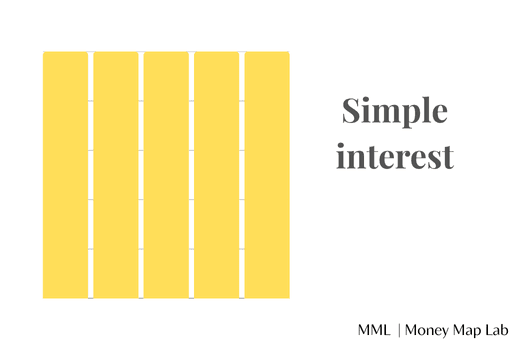
But if instead of taking those $100 every year you reinvest them, next year you won’t get paid just $100; you’ll get paid $110, and so on. It is exponential. Now imagine doing this for years and years; you would accumulate quite a big sum of money. That’s why even if retirement seems impossible from saving just a little money each month, compound interest makes it an achievable goal. But yes, it takes time, consistency, and a good reason on where you put your money.
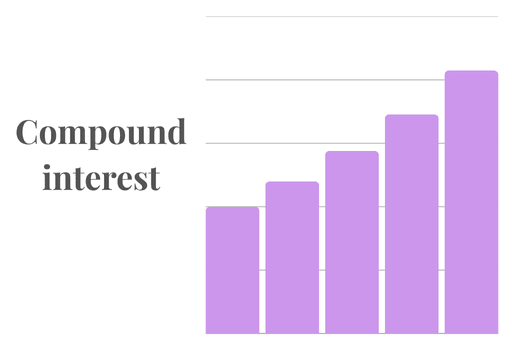
Compound interest is so powerful that Naval Ravikant says it applies to wealth, relationships, and interests:
“All the returns in life, whether wealth, relationships or knowledge, come from compound interest.” (The Almanack of Naval Ravikant/Eric Jorgenson)
Conclusion: Now you know the 5 Financial Terms
Now you know it. Compound interest means you can earn returns on your returns, and with enough time and consistency, this growth becomes exponential. You know this is important because interest rates compensate you for the time value of money, which relates to the idea that a dollar today is worth more than a dollar tomorrow because of inflation and risk on the investments you make.
And you also know that if you’re not investing but borrowing, this all works against you.