Have you ever wondered how much money do you need to retire?
Retirement often sounds like freedom. Waking up without an alarm, choosing how to spend your time, and not worrying about money. Many people dream about it, especially the idea of reaching that point earlier in life.
Not having to work for money is appealing, whether you love your job or not. The peace of mind that comes from knowing you are financially secure is powerful. That is why retirement is often seen as the ultimate form of financial freedom.
But if it is so attractive, why do most people think it is only possible after age 60? The common belief is simple: you need a lot of money.
So let’s answer the real question: how much money do you actually need?
Some Basics
Before answering the question, let’s clarify a few key ideas:
The amount of money you need for retirement depends on your situation. Your age, lifestyle, life expectancy, and taxes all play a role.
In this post, retirement means being able to live the way you want without actively earning income.
You reach retirement by saving and investing until your assets can generate enough income to support your lifestyle.
Your retirement income will come from:
Returns from investments such as dividends, interest, or rent.
Your assets themselves, by withdrawing or selling them over time
Finally, you need to know how much your lifestyle costs per year. This is the foundation of every calculation.
Now that you understand the basics, we can answer the main question: how much money do you need to retire?
Let’s look at three approaches. Two are useful and one is misleading. All of them are simple and designed to give you a clear starting point.
FIRE (Financial Independence Retire Early)
The FIRE approach is one of the simplest ways to estimate your retirement number.
The idea is straightforward:
Multiply your annual expenses by 25.
For example:
If you need 60,000 per year, you would need about 1,500,000
If you need 100,000 per year, you would need about 2,500,000
This rule is based on the idea that you can safely withdraw about 4 percent of your investments each year.
While this is a rough estimate, it gives you a quick and useful benchmark.
This method is common because it is simple, but it is also misleading.
It ignores inflation.
The formula is:
Annual expenses ÷ expected return
Using the same example:
60,000 ÷ 0.06= 1,000,000
At first glance, this looks appealing because the number is lower. But it is inaccurate because it ignores inflation.
When you compare it:
FIRE: 1,500,000
More accurate approach: 1,530,000
Wrong approach: 1,000,000
You can see how ignoring inflation leads to underestimating how much you need. Over time, this gap becomes significant and risky.
So, how much money do you need to retire?
The answer depends on your lifestyle, your goals, and your assumptions about the future.
Simple rules like the FIRE method can give you a quick estimate, while more detailed calculations can help you refine your number.
What matters most is understanding the logic behind these approaches so you can make better decisions. Using these approaches and your own estimates for expenses, inflation, and investment returns, you can calculate a number that makes sense for your situation.
The key idea is that what really matters is the difference between your investment return and inflation. The bigger that gap, the less money you need to retire.
It is important to remember that these approaches give you a simplified estimate. They help you organize your finances and think about your goals using basic math.
However, they do not include all variables, such as life expectancy, health conditions, taxes, or market uncertainty. These are factors that professionals and financial institutions usually consider in more advanced models.
Retirement is not just about hitting a number. It is about building a plan that supports the life you want.
The sooner you start thinking about it, the more options you create for your future.
How to Achieve Your Financial Goals and Non-Financial Goals in 2026
As the new year approaches, we start thinking about our goals. Which ones have we met? Which ones were left behind? And, most importantly, which ones will we set for next year?
When it comes to goal setting, money is a big part of the picture, since you are probably setting financial goals for yourself or need a budget to accomplish them.
On the one hand, financial goals may include getting out of debt, completing your emergency fund, or saving for retirement. On the other hand, goals that require money to be achieved may include going on vacation, taking a course, or donating to charity.
You see, money is something you must consider when you are setting New Year’s goals. The problem is that you sit down, write down your goals, and maybe even create your budget. Then the new year hits, with its own set of worries, the hustle and bustle of day-to-day life, and the unexpected events that just happen.
In the end, you are left with nothing but a list of good intentions and perhaps a good-looking spreadsheet with your budget. At that point, it can feel like budgeting is something you are supposed to do, not something that actually helps you live the life you want.
That cycle repeats year after year. Eventually, you may assume you are bad with money, bad at budgeting, or both, no matter how successful you are in life. In reality, you are just lacking clarity on your finances. This can be addressed with financial literacy, reflection time, and a budgeting system that focuses on the big picture, such as using our free budget template.
The issue is not discipline or motivation. Most budgets fail because they focus on tracking expenses instead of supporting the goals that actually matter to you.
This post will show you how to think about money when setting goals for the upcoming year, how to translate those goals into numbers, and how to build a budget that supports them. The focus is on aligning your money with your priorities, rather than tracking every expense. Hopefully, this will help you feel calm and confident with your money, without tracking every dollar or cutting out everything fun.
Get Our Free Budget Template
Click here todownload our free budget template in Excel. It comes with PDF instructions.
Financial goals are the specific money-related outcomes you want to achieve, such as paying down debt, building savings, or preparing for retirement.
Before starting to work on your budget, you want to think about the financial goals you want to reach in the upcoming year. Ideally, these goals should help you feel financially secure and less anxious about money.
These goals are the foundation of financial stability and reduce stress by preparing you for both expected and unexpected events.
Remember, not every financial goal needs to be fully completed in one year. The purpose of goal setting is progress and direction, not perfection.
Even though we all come from different backgrounds, some common financial goals include:
Getting Out of Debt
Debt, especially consumer debt like credit cards, is a financial burden. After all, you are paying for something you already used, plus interest.
Paying down debt is an important financial goal not only because monthly payments can take up a large portion of your income, but also because carrying a debt balance can make it harder to find financial stability in the long term.
Reducing debt also increases your flexibility, giving you more options and breathing room when life changes.
You may not be able to pay off all your debt in just one year. This depends on how much debt you have and how much of your income you can dedicate to extra payments. The first step is to align your long-term vision with a simple goal: getting out of debt completely.
To achieve that long-term vision, you should make a commitment to yourself. Your debt balance, meaning how much you owe, should always go down and never up. This principle can help keep you on track when things get difficult.
Now that you have committed to getting out of debt, you can set realistic goals for the upcoming year. For example, instead of aiming to eliminate all debt, you might set a goal to reduce your total balance by a specific amount or percentage by the end of the year.
Think of the entire year as a milestone toward your long-term goal. To do this, you need to figure out how much of your income you can use to pay down debt each month.
Somethings to consider when setting this goal:
How much you are required to pay each month according to your lender.
How much of your income is going toward debt.
Some advisors recommend following the 50/30/20 rule, which suggests allocating 20 percent of your income toward financial goals like paying down debt. This is a guideline, not a strict rule, and your ideal percentages may look different. You can read more about this here: CNBC.com
Make sure you leave money for other financial goals.
Achieving goals like building an emergency fund or saving for things you want can help you stay out of additional debt.
An emergency fund is money you have saved to cover unexpected expenses or a loss of income, from your car breaking down to losing your job. In other words, this is your peace-of-mind money.
If you do not have any emergency savings, building this fund often makes sense before aggressively paying down debt or investing. Without emergency savings, even small surprises often lead back to credit cards or loans, undoing other financial progress.
When building your emergency fund, experts recommend aiming to save between three and six months of expenses. This amount of time is often enough to help you figure out your next move when things get difficult.
Something to consider when setting up your emergency fund:
Three to six months is a general guideline, but it depends on your situation. For example, if your income is unstable, you may want to aim for nine or twelve months.
You do not need to complete your emergency fund in one year, but you should be working toward it. If this is your first year, aiming for one month may be enough.
Make sure this money is kept in a safe account that you can access easily and without penalties.
Savings lose value over time due to inflation, so try to earn some interest. Without sacrificing safety or accessibility, consider a high-yield savings account or a certificate of deposit.
Long-Term Savings
Long-term savings usually refer to retirement savings. This is money you save and invest over many years, often using accounts that offer tax advantages, such as a Roth IRA. https://www.investopedia.com/terms/r/rothira.asp
Thinking about retirement can be challenging because you are giving up money today for a future version of yourself you cannot fully picture. Still, even small contributions create long-term impact, and your future self will likely be grateful you started.
Make sure your budget includes savings for retirement. How much you save depends on your age and when you plan to retire.
If you are young and retirement is decades away, even small contributions can make a difference due to compound interest. Even setting up a small automatic contribution can be enough to get started and build consistency.
If retirement is closer or you want to retire early, you may need to save more aggressively. Reflecting on this is a good opportunity to think about how you envision your future and how you plan to support it.
Something to consider when setting your retirement goal:
Do not skip saving or investing. Even if you are unsure about retirement, setting an annual savings goal, even a small one, is better than nothing.
Try to understand the retirement and tax laws that apply to you. This can improve both investment returns and tax efficiency.
Set an annual retirement savings goal and decide whether you will distribute it evenly across the year.
The three financial goals discussed here, paying down debt, building an emergency fund, and saving for retirement, are all essential for financial success. Each one takes time before you see real results. Progress builds gradually, so do not get discouraged. Working on one goal can help you gain momentum that supports the others.
If you want help seeing how these goals fit into a full-year plan, our free MoneyMapLab budget template is designed to connect income, goals, and priorities in one place.
Non-Financial Goals
While financial goals create stability, non-financial goals are often what bring meaning, motivation, and enjoyment to everyday life.
When you think about goals for the upcoming year, money is not the only thing that comes to mind. You may want to visit a new country, lose weight, or return to school.
These goals are not directly financial, so it is easy to leave them out of your budget. However, most things still involve money. For example:
Losing weight may involve gym memberships or healthier food.
Traveling includes transportation and accommodations.
Studying can involve tuition or memberships.
Spending more time with your partner may involve dining out or occasional getaways.
There are often cheaper or free alternatives, but if you want your budget to support both financial and non-financial goals, you need to determine whether additional expenses should be included.
When these expenses are planned for in advance, you can pursue your goals without guilt or the feeling that you are “breaking” your budget. A good budget does not eliminate enjoyment. It allows you to spend intentionally on what matters to you.
For example, if you want to lose weight, you might choose to run in the park or hire a personal trainer. One option is free and the other costs money. Which one is right for you depends on affordability and personal preference.
List the goals you are setting for the year and determine whether they require money. Research your options, estimate the cost, and consider how often you will need to pay for them.
Accounting for the cost of non-financial goals helps you stay on budget. More importantly, it makes you more likely to achieve them, since you are forced to think through what they require ahead of time and cannot rely on money as an excuse later.
How to Include Your Financial Goals and Non-financial goals in Your Budget
Once you have clarity on your financial and non-financial goals, you need to assign numbers to them for the upcoming year. Determine how much you will put towards:
Paying down debt,
Building your emergency fund,
Saving for retirement,
Funding non-financial goals.
This is where having a clear annual view of your finances can make the process much simpler. To make sure your budget supports your goals:
Include these numbers in your budget
Make sure your income can cover your expenses and goals.
Revisit and adjust expenses, income assumptions, or timelines if needed
This last point may involve finding new income sources, cutting expenses, or adjusting goals.
Once your goals are included, you do not need a perfect budget or to stress about every small expense. You simply need to ensure you are moving toward your goals.
Instead of tracking every cup of coffee, review your progress at the end of the month and check whether you are meeting your goals. For instance, check that your total debt balance has actually gone down from the previous month, that your emergency fund increases and that any automatic transfer you set up is working properly.
This check-in does not need to take more than a few minutes and can often be done by simply reviewing your account balances.
Starting with long-term goals and breaking them into annual milestones helps ensure your budget serves a real purpose, not just organization.
The Budget Template That Adapts to You
If you are ready to set goals for 2026 and want a budget that helps you in real life instead of rigid rules, our free Excel template may be helpful.
It is designed for people who want clarity and direction without micromanaging every dollar, helping you see your entire year at a glance and connect your income directly to your goals.
Conclusion
Goal setting is exciting, and it is important for achieving what you want in both the short and long term. Budgeting is a tool that helps you reach your goals, but it is not meant to make you feel stressed, small, or behind. If it has, that does not mean you failed, it just means you need an easier approach.
When you shift from abstract goals to ones that align with your life vision and reflect them in your budget, you are far more likely to achieve them. A budget that supports your goals should help you feel calm, intentional, and in control of your money.
👉 Download the free MoneyMapLab budget template to create a budget that actually works for your life. Calm, flexible, and designed to grow with you. A budget that supports your goals should make you feel grounded and in control, instead of overwhelmed.
We have a whole post on how to use it, you can read it here.
Get Our Free Budget Template
Click here todownload our free budget template in Excel. It comes with PDF instructions.
How to Use Our Free Budget Template to Start 2026 With Clarity and Confidence
You want 2026 to be your best year yet and you are working on all kinds of plans to make that happen. A big part of that is getting organized with your money. That is why we created something for you inside MoneyMapLab: a Free Budget Template that helps you understand how you use your money.
Budgeting brings clarity to your income and priorities so you can direct your money toward what matters most. In simple terms, it helps you decide how you want to divide it between expenses, debt payments, savings, and wants.
Budgeting can feel overwhelming, which is why we are sharing both the template and this step-by-step walkthrough. Even though the template includes easy PDF instructions, this guide will show you exactly how to fill it out.
Get Free Budget Template
Click here to get our free budget template including PDF instructions
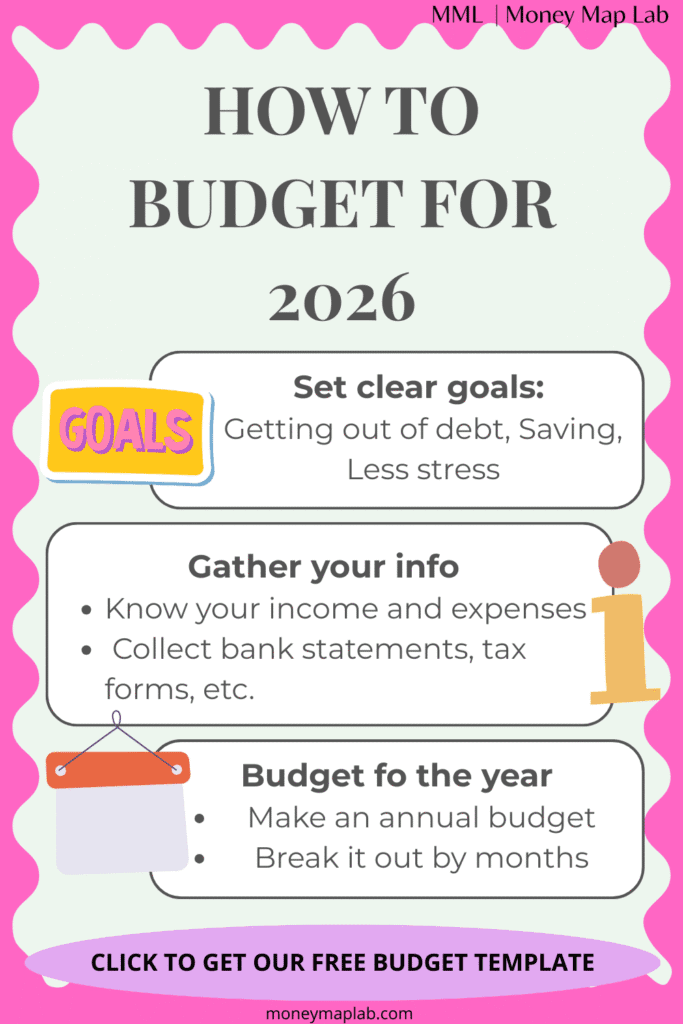
The template is designed so you create a yearly budget first. Seeing the full year at a glance gives you a clearer picture of your goals, commitments, and financial capacity.
Take a moment to identify the following:
Your income: How much did you earn in 2025 and how much do you expect in 2026? List all sources.
Your expenses: Make a list of everything, from rent and groceries to trips and yearly payments. Reviewing this year’s bank statements helps avoid missing anything.
Our budget template has 3 tabs:
Annual Budget: This is the most important tab. Here you’ll think in annual terms for both your income and expenses.
Monthly Budget: Once you have your annual budget figured out, you’ll break it down by month.
Tracker: This tab is optional. Once a month you can fill it with your actual income and expenses. It shows you the comparison with your budget and adds them up as the year goes by.
We’ll walk you through each section of the template so you understand exactly how to fill it out.
ANNUAL BUDGET
The purpose of this tab is for you to:
Understand your annual income.
Decide how to divide it between needs, debt payments, savings, and wants.
Set your financial goal for the year.
Check that your budget aligns with your goal.
Ensure your total income covers your total expenses.
Now we can start. Go to the Annual Budget tab.
How to Fill the Annual Budget Tab
INCOME SECTION
List each source of income. The sheet gives you space for three sources, but only fill what applies. For instance: main job, side hustle, and dividends.
For each one, include the Frequency, meaning the number of months you receive it. For example, a salary usually has a frequency of 12 while a seasonal side business might have 1.
Feel free to adjust to your own situation. Maybe you don’t have income from different sources but expect a bonus in the middle of the year.
Once you fill this in, check the total income calculated on the right to make sure it looks accurate.
Some Things to Consider
Do you have irregular income?
If you have irregular income, use the template to commit to a realistic minimum you can count on each month. Perhaps you need to make an extra effort to collect relevant information to guide you, go through your bank statements or any other relevant document to calculate your total income for the year. From there, establish a goal for next year.
We recommend using your after-tax income. It is probable your employer or clients will subtract a portion of your income tax before paying you. This is the easiest number to use for your budget.
Alternatively, you can use your before-tax income, but if you do, be sure to also include all mandatory deductions like taxes, retirement contributions, and insurance premiums as expenses.
EXPENSES SECTION
Below the income section, you will enter your annual expenses. The template groups expenses into four categories:
Needs: Essential costs such as rent, food, and insurance.
Debt: All annual debt payments including interest and principal. It could be the minimum payment, but ideally it should be aligned with your debt paydown plan.
Savings: Short-term goals like vacations or emergencies, and long-term goals like retirement.
Wants: Non-essential spending such as restaurants, entertainment, and shopping.
If these categories do not reflect your situation, you can rename them and the sheet will update automatically.
Freelancers or business owners may prefer different categories, like supplies, memberships and technology. Our post Mastering Freelance Money: 7 Easy Steps to Reduce Money Stress may be useful.
Also remember to include irregular or unexpected expenses. A small buffer helps prevent surprises.
Make the budget your own. We are all different and what might be a need for one person may be a want for another. Don’t stress over finding the right category; just put it where it feels right for you.
Amount and Frequency
For each expense, enter the annual amount and how many months of the year you pay it, the Frequency. For instance, for rent, which you pay every month, you should write down 12.
While most expenses like rent or groceries are paid month to month, there are some expenses we don’t pay every month. Make sure you don’t forget these, like insurance, Christmas gifts, memberships, car maintenance, and so on.
For annual or irregular expenses such as insurance or gifts, choose whether you want to save for them monthly or assign them directly to the month when they occur.
Save up for that expense. In this case, you can write 12 as the frequency and put that money away each month. This way, when the expense comes, you’ll be ready.
Put it exactly in the month it is due. This could make sense if you have additional income that you can use specifically to pay for it.
The sheet calculates the total for each category and displays a visual breakdown on the right.
Please note that technically savings or debt payments aren’t expenses, and other items you include may not be either. For simplicity, we call all cash outflows ‘expenses,’ even though some, like savings or debt payments, are not technically expenses in accounting terms.
Get Free Budget Template
Click here to get our free budget template including PDF instructions
After entering all your income and expenses, check your balance. It is automatically calculated as Income minus Expenses.
The ideal balance is zero, meaning you have assigned every dollar a purpose. If the balance is positive, you can add it to a category or leave it as a buffer.
If it is negative, review your numbers and adjust until your expenses do not exceed your income. A negative balance means you’re spending more than you’re bringing in, which usually ends up being covered with consumer debt.
This could be an easy fix: perhaps you missed something, forgot a source of income you usually receive, or overstated some expenses. But if you review it and all your numbers look right, then you need to do some additional work.
Either try to come up with a new source of income or find expenses to cut. Don’t get discouraged! This is why you are budgeting, to find out what’s wrong and correct it. This is how you improve your finances.
This is also the best moment to write down your financial goal for the year in the space provided.
MONTHLY BUDGET TRACKER
The annual sheet does most of the planning work. There you really needed to gather your information and plan for next year.
The monthly sheet helps you distribute that plan into actual months.
In the first columns you’ll see your annual budget organized: first your income, then your expenses, and your balance at the bottom. You’ll also see an Average column, which is the amount you are expected to spend each month for each item. It is simply the division of your annual total by the number of months you set as the frequency.
For instance, if your annual salary is 50,000 and you put 12 down as the frequency, the “Average” column will show 4,167 (50,000 ÷ 12). If you pay for a 500 membership each July and you put 1 as the frequency, the “Average” column will show 500.
The purpose of the “Average” column is to give you an idea of the value you need to include each month for each concept included in your annual budget. However, you don’t need to use it if you don’t want to.
In this sheet, you’ll see one column for each month of the year, and many cells colored in light green. You need to fill those green cells with the amount you expect to pay for that income or expense. Use the Average column as guidance if you want to, or enter values manually.
The Check column confirms whether the monthly totals match your annual plan.
Finally, at the bottom, you’ll get each month’s balance.
Unlike with your Annual Budget, with your Monthly Budget you do not need a positive balance every month, but you do need to monitor it. Positive months may need to fund negative months, so set money aside accordingly.
TRACKER
The Tracker lets you compare your budget with your actual spending as the year progresses.
It is optional because tracking every detail takes time. Tracking is not for everyone, and it is time-consuming.
If you complete the other tabs, you already know your numbers. Even if you don’t track every detail, you should still check in regularly to make sure you’re staying aligned with your goals.
Your debt balance isn’t increasing
Your savings account is being funded regularly, and the total balance matches what you expected
You’re able to make all your payments on time
In general, you are accomplishing what you expect
Especially if you set the right systems in place to send your money exactly where you want it to go, you might not need to be too strict about tracking. Just checking that you’re meeting your goals is enough and that can be done by checking your accounts.
If you like to track everything or are really struggling financially, you should use the tracker. It will give you the details you need to make better decisions.
Both the annual and monthly budget sheets feed the tracker automatically; this is what you are comparing reality to.
If you decide that tracking is for you, you need to manually fill the green cells. To do this, set aside weekly time and write down what you have paid for. Each week, either erase it and put the updated value or, if you have some Excel skills, add the new information.
If you want to avoid manual entry and prefer a fully automated system, you can get our ultimate budget template here.
Get Free Budget Template
Click here to get our free budget template including PDF instructions
Budgeting is one of the most effective tools to bring order and intention to your finances. This simple budget template will help you start the year knowing exactly what your financial goals are and how to get your money to work for you.
Loud Budgeting Is Out: Here’s What Actually Improves Your Finances
Loud budgeting was introduced by writer and comedian Lukas Battle at the end of 2023. It quickly became the personal finance trend of 2024, with countless TikTok and Instagram posts explaining it or showing how people use it in their daily lives.
What began as a lighthearted meme struck a chord. Many people were (and are) struggling with soaring prices and economic uncertainty.
It gave people a way to stop pretending they can afford everything and to stop silently stressing about money. They could speak up, set boundaries, and be honest about what they can and can’t spend.
But what exactly was the loud budgeting trend?
Loud budgeting is the concept of openly communicating how you want and don’t want to spend your money, freeing yourself from the social pressure associated with it.
It started as a humorous TikTok with a serious root, as a reaction to financial pressure. It was never meant to be a formal financial strategy.
As Lukas Battle puts it, it’s about being able to say, “I don’t want to spend.”
As the trend grew, people shared examples like:
I don’t want to spend money on going out with my friends.
I don’t want to spend money on an overhyped bachelorette party or trip for my friend.
I don’t want to spend money on the latest sneakers to impress my friends.
Interestingly, many people saw it as the opposite of a fashion trend that took off at the end of 2023, “quiet luxury.” While this trend emphasized mindful spending, it was very celebrity-driven and potentially involved spending large amounts of money on fashion items. Elle Magazine defined it as:
“new-age minimalism, with a larger focus on investment pieces and thoughtful shopping habits.”
To sum up, loud budgeting was a concept introduced on social media that encourages people to prioritize their financial goals by transparently sharing them as the motivation behind their choices to not engage in certain activities.
What are the ups and downs of loud budgeting?
The upsides of loud budgeting
Normalizes money conversations We are just not used to talking about money. While in recent years we’ve seen more and more social media creators on this topic, we still have a long way to go before it stops being a taboo subject.
Encourages conscious spending Saying decisions out loud forces clarity: Is this purchase worth delaying my goals?
Strengthens self-confidence Loud budgeting is not just about money; it’s about putting your values and goals front and center. Saying no to activities or purchases that don’t match your goals can feel uncomfortable at first. But it also shows you are capable of doing it.
Creates community accountability Friends who share financial goals support each other instead of pressuring one another to overspend.
Reduces anxiety Transparency removes the constant inner debate of pretending you can afford things you can’t or would rather not.
The potential downsides (and how to avoid them)
It can turn competitive and performative If everyone posts their savings milestones, the conversation can shift from empowerment to comparison.
It can oversimplify complex realities Some people can’t “just say no” to expenses, especially with family or cultural obligations. Helping loved ones, showing up for special moments, or supporting your community can be nonnegotiable.
It might expose privacy you’re not ready to share You decide how “loud” you want to be.
It’s not a financial strategy Loud budgeting can be a tool to help you prioritize how you spend your money and even your time, but it is not enough to make sure you’re on the right track financially.
Should you be loud budgeting, or was it just a trend?
Loud budgeting was just a trend, but that doesn’t mean it didn’t make an impact. Most social media and website posts about it date to late 2023 and early 2024, and it was never intended to be serious financial advice.
Your financial decisions should be based on your specific situation, your personal choices, and your long-term goals. It’s never okay to base them on a social media post, even if it goes viral.
However, it’s fair to recognize that loud budgeting had a positive effect on personal finances and taught us some useful lessons.
For one, it openly addressed something we have all struggled with: how to say no when we don’t want to spend on something but feel like we can’t, for reasons like:
We don’t want to hurt someone’s feelings.
We don’t want to appear cheap.
We don’t want to be left out of our social circle.
Whatever the reason, the loud budgeting trend showed we are not alone.
It also got people talking about money. The truth is we still don’t talk about it enough because it is often seen as a taboo or even rude topic. We don’t even get financial education at home, at school, or at university.
Finally, it made it okay to set boundaries based on a financial reason. By saying no to brunch, a night out drinking, or a visit to the mall, people put mindful spending front and center. It made financial boundaries feel normal.
Loud budgeting added to the conversation about personal finance, but by itself it won’t fix your finances.
If you’re not budgeting loud, what are you supposed to do?
Let’s face it. Your finances won’t magically improve just because you skip Sunday brunch with your friends. You need to go above and beyond, but the good news is it can be really easy.
As a matter of fact, just budgeting the right way will do most of the heavy lifting.
Make your finances a priority: If you know about loud budgeting and you are reading this article, you probably already are on the right track.
Reflect on what exactly it is you want to achieve: Do you want to save for something? Do you want to invest? Do you want to stop living paycheck to paycheck? Do you want to stop feeling anxious about money? Having a goal will make day-to-day decisions easier.
Identify what your income is and how you spend it: Yes, this may be obvious, but sometimes we just lose track.
Make a budget: Budgeting isn’t about saying no; it is about planning to meet your goals. In MML we recommend making an annual budget and then turning it into months. This means estimating your income and deciding how it will be spent, saved, and invested. For example, decide how much of your income you’ll use for daily expenses, how much for short-term savings, and how much for retirement. If you need help with your budget, you can download our free budgeting template here.
Make sure you know where your money is going and you have the necessary accounts or products:
For example, if one of your goals is to build your emergency fund and you’ve included it in your budget, you need to know where you’re keeping this money. For example, a high-yield savings account. Or if your budget includes health insurance, then make sure you acquire one that meets your needs.
Set up systems that make it easier to stick to your budget: Your budget will tell you how your money should be distributed each month.
Having the right accounts and products helps you avoid decision fatigue and know exactly where your money should go.
Now make sure that distribution is easy and effortless. Set up automatic transfers when possible. You can also charge bills to your credit card, as long as you pay it in full each month. Or set aside an hour on payday to send your money where it needs to go.
Track your budget: If done right, you don’t need to track every cent you spend, specially when your system is set up and stable. If you follow the previous steps, your money should go exactly where you want it to go. So instead of tracking, just use your budget as a checklist to make sure you paid all your bills and your money was sent to the accounts or products you intended it to go. This way, any money left is yours to spend. Ideally, that amount comes from planning your budget carefully.
Review and repeat: Your budget isn’t set in stone, so review it occasionally, adjust what isn’t working, and keep going. A light review once a month and an in-depth look every three months seems to work.
By implementing this budget framework, you are not just saying no as your financial strategy; you are being mindful about your goals, your month-to-month decisions, and where you’re putting your money.
If done right, you should get some peace of mind. You set your goals and your systems so you know for sure you are meeting those goals one step at a time. Basically, you’re sending your money toward those goals, and if money is left in the bank, you can spend it guilt-free. Perhaps you don’t need to say no as often as you thought.
If you want to budget but dont know were to start you can read our post Personal Budgeting 101: 10 Simple Tips to Master Your Money
Should you forget about loud budgeting?
Maybe not. Loud budgeting is just a trend and not a long-term financial strategy. But it can still be useful once in a while.
Let us explain. If you use the budgeting framework we described, you should gain clarity about your finances and, after a few months of execution, reduce money-related stress.
Your system should lock your money in place. This helps ensure it goes where you intended. This ensures the money goes where you intended. This means you really shouldn’t have more money available to you than the amount you expected to spend. So, no need to use loud budgeting.
However, loud budgeting can be a good tool to follow two very important rules to secure your financial health:
•Rule #1: No consumer debt.
Ideally, you shouldn’t have any consumer debt (like credit cards), but if you do, you should aim to keep it from increasing its balance. You can afford to make a few unwise choices with the money already set aside in your budget, and loud budgeting won’t really help you advance your financial goals.
If you can’t pay for something the moment you want it, you can’t afford it. And if loud budgeting helps you step back from a purchase, use it.
Note: This doesn´t mean you can’t have a credit card, it just means you have to use it wisely and avid carrying a balance.
• Rule #2: No taking money out from savings and investments.
All your budgeting, planning, saving, and investing can go to waste if you take money out whenever you want.
Unless it fits your intended use of the money you have saved or invested, you just can’t use it. For instance, if your car breaks down, you can take money from your emergency fund, since this is what it is for, but you can’t if you find a super good sale on Black Friday.
This is especially true for long-term investments, since you risk withdrawing money at a bad time, facing penalties, or losing tax benefits.
The bigger takeaway: we need to talk about money more
Money touches every part of life, yet many of us don’t have the knowledge we need to manage it well. Loud budgeting shows that we are ready to talk and learn about money. You don’t have to announce every spending decision online. You just need to know your numbers, set boundaries, and talk honestly with the people who matter. That’s how financial literacy becomes financial freedom.
Next step: make your budget clear and confident
Understanding your money starts with seeing it clearly. Download our free budgeting template to organize your income, expenses, and savings goals for the whole year and month by month in a simple, clear way.
📎 Click below to get it instantly and start building a budget you can feel proud of.
Get Free Budget Template
Start budgeting with our simple easy to use template.
It’s just a few weeks before 2025 ends. A lot happens this time of year, and it can feel overwhelming. You’re juggling clients, deadlines, and plans for next year, but that can’t be an excuse to put your business finances on the back burner.
These last few weeks could be your final chance to take action with your freelancer tax checklist, avoid overpaying taxes, and skip the nasty surprise when tax season arrives.
You’ve worked hard all year to build your income and independence. The last thing you want is to let taxes undo your progress. There are two main reasons that can happen.
The first reason is simple: it’s money. You may end up paying more taxes than you need to just for being disorganized, not keeping proper records, or just not understanding how taxes work.
The second reason is time. You want to be able to be as focused as possible on your business; after all, you are the one who makes it work. But if tax season comes and you’re unprepared, it will take a lot of your time and will be an incredible source of stress.
If you take a few clear steps before the end of the year, you will reduce stress, avoid last-minute scrambles, and have a much better read on your money.
This freelancer tax checklist is based on general principles and aims to let you see what you may be missing. While taxes differ by country and situation, some basics apply everywhere. Use the steps below to organize records, lock in deductible expenses, estimate what you owe, and create a small cash buffer so you start 2026 with less financial worry.
How to Use This Freelancer Tax Checklist.
Read this freelancer tax checklist once now. Identify the points where you need to work and start with the most time-sensitive. Remember, you only have until the end of the year.
1. Find Out Where You Stand
What you need to know
As a freelancer, taxes depend on your income. In most countries, you can subtract certain expenses to find your tax base: the number used to calculate your taxes. You may even be able to include your contributions to pension plans.
See our post to find the definition of “tax base.” See Post
Why do you need to know it?
You don’t want 2026 tax season to come along and find out you missed the opportunity to legally and rightfully include an expense or a retirement contribution for the calculation of your taxes. It will be too late by then.
What’s the problem?
You can’t think about your tax base if you don’t have a clear picture of how 2025 looks so far: your income, your expenses, and what’s still coming in. Ideally, you will have all your records organized (which we’ll talk about later), and it will be easy for you to find this information, but even if it isn’t, try to get some rough estimates.
Why a rough estimate?
You don’t have much time before the year ends, and gathering all your records can take a while. It might be a lot of information, require help from a third party, or just feel so boring and daunting that you put it off.
What to do?
Try to figure out two key numbers as quickly as you can, even if roughly: your income for the year (including a quick estimate for the last few weeks) and your total business expenses. A reference for your tax base will be the difference between your income and your expenses.
Once you have those rough numbers, it’s time to back them up with solid, organized records.
2. Gather and Organize Your Records
Why it matters
This step is a continuation of the previous one. In the first step, you created a point of reference. Now we’ll go deeper with two goals:
Make sure we didn’t miss anything from our rough estimate.
Have all the supporting papers (digital papers, that may be) that the tax authority could ask for.
You cannot estimate taxes, claim deductions, or see your real profit if your paperwork is scattered. A quick, consistent system saves hours later.
Action steps
Pull every invoice, receipt, bank statement, and payment record for the year into one folder. Digital folders are fine. Use a naming system like 2025_ClientName_Invoice, it makes searching and sorting easier later.
If you have paper receipts, scan or photograph them now and add the images to the folder.
Make a single spreadsheet or simple bookkeeping file with columns: date, client, amount, category (income, expense type), and notes. Even a basic sheet gives immediate clarity.
Add total income and total expenses. Do they match your initial estimate?
If you want a simple Excel spreadsheet to track your income and expenses, you can get one of MML’s templates on Etsy.
See our resource section
See our resource section
Click here to change see our free budget template and other resources.
Try organizing your digital folders by month (January to December), and inside each month create one folder for income and another for expenses. You can add more categories if needed. Just remember that too many folders can be hard to keep organized and make files tougher to find later.
With organized records, you can now be sure of the two numbers that matter: how much you earn (income) and how much you spent (expenses). If this matches your rough estimate, it’s great. If not, try to find the difference, start with the biggest items and work your way down.
With your records in order, you’re ready to make sure you’re not missing any tax-deductible opportunities.
3. Identify Deductible Expenses and Lock Them In
Why it matters
As we mentioned earlier, most countries allow certain business expenses to reduce taxable income. This is called a deduction. If you miss deductible items, you lose an easy, legal way to lower taxes.
Action steps
By now, you already have your expenses identified from steps 1 and 2; use those as a reference.
Review your expense list and mark items that relate directly to your business: software, supplies, home office portion of rent, professional services, subscriptions used for work, education, and business travel.
If you have included expenses that do not match these criteria, chances are you won’t be able to use them to lower your tax base.
Confirm rules in your country or region regarding timing and criteria to consider an item deductible.
If you have expenses that don’t meet the criteria but could, take the time to fix that now. For example, if you require a receipt but don’t have it, try to get a copy where you made the purchase.
Usually, expenses incurred before the calendar year-end count for that year. If you can make a qualifying purchase this month, do it now.
For items that are partly personal and partly business, record a conservative split and keep a short note explaining the allocation.
Review and adjust your total expenses based on the previous steps. For instance, if you conclude that an item is not deductible, eliminate it, or if you are able to include an additional purchase, add it.
Example
If a new laptop is needed for work and you were planning to buy one anyway, purchasing it before year-end can often mean that you claim it in the current tax year.
To learn more and complete your freelancer tax checklist you can visit
Investopedia has a great series on this topic : (Click here)
If you’re in the US, the IRS has some free resources you can consult: (Click here)
Once deductions are accounted for, you can estimate a more accurate taxable base figure.
Once your deductible expenses are locked in, it’s a great time to look at one more tax-saving opportunity: your retirement contributions.
4. Make One Retirement Contribution If Applicable
Why it matters
Saving and investing for the long term builds financial security, especially when those savings will fund your retirement. Since you are already supposed to be saving for retirement, the fact that many countries allow you to use your tax contributions to lower your taxes is great.
Depending on your situation, retirement contributions may be tax-exempt now or taxed later when you withdraw them, either way, you benefit.
Why now
Many retirement or pension accounts accept contributions up to the end of the calendar year. A single contribution can reduce your tax base. As we mentioned earlier, this will not only lower taxes but will help your future be more financially secure.
Action steps
You should be prioritizing retirement, and if you already have a savings goal, great. Just check if in your country there are retirement accounts that offer tax benefits and get one if you don’t already have one.
If you are not actively saving for retirement and are trying to close the year as best as possible, that’s ok. Check if you have available cash to put toward retirement. If your income minus your expenses results in a positive number, you probably do, but double-check.
In either case, if you have a retirement option for independent workers in your country, review contribution rules and deadlines. Contribute if it makes sense for cash flow and tax planning.
If you are unsure, prioritize research. Most countries provide free and widely available information. Plus, financial institutions that offer these kinds of accounts will have people available to offer you guidance.
Some tips for your research regarding retirement accounts
This is your money for retirement. You can’t afford to lose it, so do good research.
There are only a few weeks left in the year, so you are working with a tight timeline. Prioritize reputation and safety over profitability. You can always change your account or open a new one next year if you find a better option.
Do a little window shopping and visit three to five providers that offer these types of accounts. This will not only help you choose one but will give you information about the relevant features.
Make a list of your main concerns and ask them. Some examples are: Are there special accounts for freelancers? How can I be sure it will qualify to lower my taxes? How long do I need to leave my money locked in? What happens if I need my money earlier? How will my money be invested? What has been the average profitability of this kind of account in the last year, 5-year, and 10-year period?
Retirement contributions are long-term and reduce tax stress now and in the future.
With your retirement contributions handled, let’s make sure you’re financially ready for what comes next: paying the actual tax bill.
5. Estimate What You May Owe and Set Aside the Cash
Why it matters
Freelancers who wait until the filing deadline are often surprised. Estimating now prevents cash shortfalls and high stress later.
The last thing you want is to lock up your cash in a retirement account, or spend it on holiday cheer, only to realize you don’t have enough left to pay your taxes.
Yes, retirement savings are important and a great way to lower your taxes but make sure your cash flow can handle locking that money away long term.
Action steps
Use your organized income minus deductible expenses to estimate your taxable profit. Apply a conservative tax rate to that number to estimate liability. If you are unsure of the rate, use a conservative assumption, such as 20 to 30 percent, and adjust once you confirm local rates.
Put that estimated amount into a dedicated savings account. Treat it as untouchable money until you finalize actual tax calculations. If you don’t have the money, start saving it.
If you make quarterly estimated payments in your country, check whether another payment is due soon and plan ahead. These payments usually count as prepaid taxes, so subtract what you’ve already paid from your estimate.
Example
If you estimate that you will owe $6,000, put $500 per month aside for the next 12 months or the remainder needed before the filing date. If you have only two months, prioritize setting aside a larger portion now.
Having a tax reserve reduces worry and prevents you from selling investments, using your emergency fund, or getting into debt at the worst possible time.
Bottom line: knowing you can pay your taxes means peace of mind later.
6. Review Your Cash Flow for the Rest of the Year
Taxes are a result of your business. So, even though it doesn’t feel great to pay them, having to do so is usually a good sign that your business is generating profit.
But profit isn’t the same as cash flow (click here if you want to dig into the difference). Make sure your business is strong on both fronts, so you can cover purchases, make contributions, and meet your tax payments comfortably.
What can you do:
Check if you have outstanding payments from clients (unpaid invoices). If you do, politely remind your clients.
Check if there are any invoices you haven’t sent yet: maybe you forgot, or your client hasn’t given you the final approval.
Check if you’re still paying for unnecessary expenses, like subscriptions you don’t use. It’s pointless that this is deductible from taxes if you don’t get any value from it. Cancel them to start the year without this burden.
If you don’t have an emergency fund, start one, even if at first it is not very big. This will give you a sense of safety and will buy your business some time when obstacles arise.
Set aside some time to plan for next year; this will give you clarity to make better decisions.
Once your cash flow is clear, you’ll have a solid foundation to finish the year strong and start the next one with less stress.
Final Thoughts about your freelancer tax checklist
You don’t need to fix everything at once. But the year is ending, and tax season isn’t something you can avoid. Avoiding this reality won’t get you anywhere. Instead, make a quick list of what resonated with you from this post. Those are the critical issues to focus on first. Identify reasonable actions you can take to start and address them. Start by committing to setting aside 30 minutes this week to start working on these issues.
Save this freelancer tax checklist for next year to stay ahead. You’ll thank yourself when tax season arrives and you feel calm, prepared, and confident.
5 Financial Terms Everyone Should Know (So You Can Finally Feel in Control of Your Money)
What do you think when you hear the word finance? Perhaps you imagine a Wall Street guy screaming on some exchange floor, complicated math, or a very boring meeting. You’re not wrong to think of these examples, but finance simply refers to the management of money.
So, if you use money to buy food, pay rent or a mortgage, or cover other everyday expenses, it helps you to learn some basics of personal finance. Knowing these basics can reduce money-related anxiety and give you a greater sense of control.
In the next sections, we’ll break down five financial terms that can help you stay ahead with your finances: Inflation, Risk, Time Value of Money, Interest Rates, and Compound Interest. You’ve probably heard most of them, but do you really know their meaning and how they affect your life? Do you know how they relate to one another?
1. Inflation: The Silent Pay Cut
In the last couple of years, we all got more than familiar with inflation. After the pandemic, prices surged, and suddenly, your paycheck didn’t allow you to purchase what you were used to.
So, what is inflation?
Simply put, inflation is the general increase in prices in the economy. It is usually measured based on a determined basket of goods and services, and economists evaluate how much it increased or decreased from one period to another.
Some inflation is good. As a matter of fact, the central bank of most countries sets an inflation rate target, which in the US is 2%.
The problem arises when inflation is too low, negative, or — as we are seeing — too high. Which is exactly what happened in 2022, when inflation started to increase, reaching 8%. While today, in 2025, inflation has been on a downward trend, it is still above the target.
If your income doesn’t increase at the same rate as inflation, your lifestyle will be affected, since you won’t be able to purchase the same amount or quality of goods and services as you could before.
Imagine you normally spend $1,000 on groceries each month. First, you might notice prices are slightly higher, maybe $1,005. Over the months, costs continue to rise to $1,080, $1,090, or even $1,100, as happened in 2022
The problem is that prices rarely go down, so even if inflation starts to normalize, we are all stuck with the new price levels.
Your savings lose value over time: Since prices are increasing from one year to another, you won’t be able to purchase in the future what you can purchase today with the same amount of money. This means that if you have savings, your savings will lose value over time. To prevent your savings from losing value, you need to invest them depending on when you plan to use them — this could be in a high-yield savings account, stocks, bonds, etc.
What can you do about it?
Get familiar with the concept of inflation, which you are doing by reading this post.
Get acquainted with inflation in your country. You don’t need to become an expert, but try to figure out the answer to these 3 questions: Is there an inflation target? What is the current inflation rate? Is inflation expected to go up or down?
Organize your finances: budget, build an emergency fund, save, and invest. You can read the MML article on budgeting here.
Avoid lifestyle inflation. You can’t control inflation, but you can control your money. Learn how to avoid lifestyle inflation here.
Increase your income: We know this is easier said than done, so this is a medium- to long-term move. But make sure you negotiate salary increases, take on a side hustle if you need to, and keep upgrading your skills.
Watch your expenses: If money feels tight, like in the grocery trip example, try to be flexible, change brands, find cheaper stores, and find creative ways to save. Read this post for some ideas.
Make sure your money is growing, whether it is in a savings account or invested.
2. Risk — The Cost of Uncertainty
Do you associate risk with something good or something bad?
We often associate risk with something bad, but in reality, the risk we take can have both positive or negative consequences, since risk just refers to how much the result could vary from what you expect.
The Corporate Finance Institute actually defines it as:
“The probability that actual results will differ from expected results.” (CFI)
Imagine you buy Apple’s stock and expect it to go up by 10% over the next year. Your risk is actually that the actual return of Apple is above or below that 10%.
But this definition doesn’t apply just to finances; it applies to all aspects of life.
From everyday life, like visiting a new restaurant and taking the risk of it being better or worse than expected, to key life decisions like marrying someone who can be the perfect companion or a mismatch.
In business, if you’re a freelancer and you depend on just one client, your expectation is keeping that client; your risk is losing it. Other business-related risks can relate to giving time for your clients to pay you, getting too much debt, or depending on one key person.
Two important takeaways about risk:
Risk can’t be avoided if you want the reward that comes with it, but it can be managed and mitigated. In the restaurant example we mentioned previously, the reward you’re seeking is that you want a delicious meal. The risk is that it can be a really good or bad experience. The way to manage it is to do some research before going there, like checking Google, Yelp, or asking a friend for recommendations.
When you’re willing to take more risk, you’re most likely expecting a bigger reward. While this may not apply to everyone, especially daredevils who love risk for its own sake, it is true for most of us and is a key principle in finance.
Imagine you can invest in Apple stock or in a new venture started by a colleague. Would you require the same return from both of them?
In theory, you should answer no. Since Apple is a proven business, you are probably willing to invest in it even if its return is lower than your colleague’s venture.
If in a year’s time you expect Apple to give a 10% return (this is a made-up number), you would need your colleague’s venture to have the possibility to give you a higher return, 20%, 30% (again made up).
In finance, a very important concept related to risk is diversification, which basically is the idea of not putting all your eggs in one basket. But this is a topic for another day.
Why you need to understand risk
Because it affects your everyday life.
How can you handle risk?
Make decisions considering the risk–reward tradeoff.
Figure out ways you can manage or reduce risk: research, diversification, insurance.
Take risks you understand and don’t have life-changing consequences.
3. Time Value of Money: The Secret Power of Starting Early
The idea that a dollar today is worth more than a dollar tomorrow.
Yes, you guessed it, this relates to both inflation and risk.
Why? The dollar is worth more today than tomorrow because of inflation. As prices increase, you won’t be able to buy the same things you can buy today a year from now.
This means that if you don’t use that dollar today, you need to invest it so it makes a return at least as high as the inflation rate.
But investing only keeps pace with inflation if you put your money in a very safe option, where you are confident, you’ll get your dollar back.
But what if it’s a riskier investment? Then you need a higher return, not just to keep up with inflation, but also to account for the possibility of losing your money.
What to do with the concept of Time Value of Money?
Save your money but also try to invest it.
If you might need that money in the short term, find low-risk alternatives, even if they offer low returns. Here the goal is to avoid inflation from eating your savings. High-yield savings accounts from reputable institutions, treasury bonds, or Certificates of Deposit are good ideas to look into.
If you’re saving for the long term, like retirement, you can probably take on more risks, but now you can assess that risk considering the return tradeoff.
You’ll still need to do research, learn about each option, and perhaps get a professional advisor, but now you’re better equipped to handle their advice.
4. Interest Rates: The Price of Borrowing (or Reward of Saving)
Interest can either take money from you or pay you, depending on whether you’re investing or borrowing.
Interest is the cost of borrowing money or the reward for lending/saving it and is usually expressed as a percentage. If, for example, you have a credit card, you will pay interest when you use it and keep a balance, but if you open a high-yield savings account, you will receive interest.
Suppose the interest rate is 10% a year and you invest $1,000; in one year you will get $1,100 — $1,000 initially invested plus $100 worth of interest.
Why is it important?
Interest rates reflect the expected inflation and risk you’ll be taking when you make an investment or the risk being taken by the bank when it lends you money. An example of this is the comparison between interest rates on credit cards and mortgages. While today credit card interest is around 21% (Federal Reserve), mortgages are around 6%.
Think about it: the bank can’t use most of the items you buy with a credit card, so if you don’t pay, they risk losing money. With a mortgage, if you can’t pay, the bank can take the house and sell it. This makes mortgages less risky for banks, and over time, increases in property value and rental income help compensate for inflation.
5. Compound vs. Simple Interest: The Quiet Millionaire’s Formula
Knowing the difference between simple interest and compound interest is the key to understanding how your money grows over time.
Simple interest is calculated only on the original amount lent or borrowed; it is not reinvested. If the interest rate is 5% and you borrow $100 for 2 years, you pay $5 in interest in Year 1 and $5 in Year 2.
Compound interest is calculated on the original amount plus any interest that has already been added. If the interest rate is 5% and you borrow $100 for 2 years, you pay $5 in interest in Year 1 (5% × $100) and another $5.25 in Year 2 (5% × $105).
Why does this matter?
With simple interest, you’ll earn (or pay) the same amount periodically, so growth is flat. For example, if you invest $1,000 at 10% per year for 5 years, you would earn $100 each year.
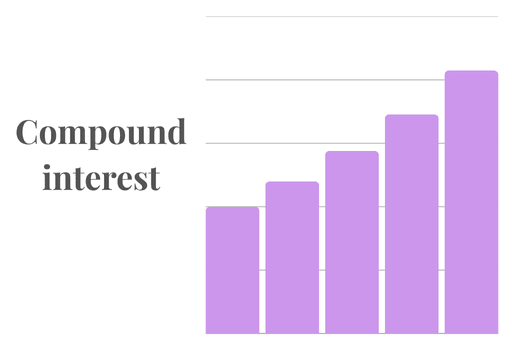
But if instead of taking those $100 every year you reinvest them, next year you won’t get paid just $100; you’ll get paid $110, and so on. It is exponential. Now imagine doing this for years and years; you would accumulate quite a big sum of money. That’s why even if retirement seems impossible from saving just a little money each month, compound interest makes it an achievable goal. But yes, it takes time, consistency, and a good reason on where you put your money.
Compound interest is so powerful that Naval Ravikant says it applies to wealth, relationships, and interests:
“All the returns in life, whether wealth, relationships or knowledge, come from compound interest.” (The Almanack of Naval Ravikant/Eric Jorgenson)
Conclusion: Now you know the 5 Financial Terms
Now you know it. Compound interest means you can earn returns on your returns, and with enough time and consistency, this growth becomes exponential. You know this is important because interest rates compensate you for the time value of money, which relates to the idea that a dollar today is worth more than a dollar tomorrow because of inflation and risk on the investments you make.
And you also know that if you’re not investing but borrowing, this all works against you.
5 financial mistakes to avoid if you want to be a millionaire
You can dream the life — the house, the car, the freedom.
Imagine waking up one day in your dream home. You’ve got the car you’ve always wanted, time to travel wherever you wish, and not a single worry about how to pay for it all.
But the harsh reality? Most of us aren’t living that dream. In fact, many of us struggle to make it to the end of the month.
Whether you’re just starting your financial journey or have been trying to build wealth for a while but feel stuck, these are five money mistakes that are keeping you from becoming a millionaire — and what you can do to fix them.
1. Money Mistake # 1: Not Keeping a Budget
It took me about four or five years to realize I needed a budget — something I’m not exactly proud of as a finance graduate. I always thought budgeting was for businesses, not individuals. My finances didn’t feel “important enough” to plan for.
Looking back, I wish I had started sooner. But I’m grateful I finally did, because budgeting truly changed my life.
Without a budget, you have no clear understanding of three key aspects of your personal finances:
How much money you earn each month.
How much you spend.
What goals you’re actually working toward.
Without that awareness, it’s easy to overspend on things that don’t truly matter — coffee runs, clothes, home decor, or nights out.
Overspending leads to one of two things: running out of money before the month ends or relying on credit cards to make up the difference. Both make it harder to think about the future and save for the things that really matter.
Creating a budget changes everything. You get a clear look at your income and expenses and can start setting small, achievable goals. A coworker’s personal budget actually inspired me to start mine — and it was a game changer.
Budgeting helps you move from barely making it each month to finishing strong and even setting money aside for what’s next. It doesn’t matter how you budget — whether it’s an app, a spreadsheet, or a notebook — what matters is the clarity it gives you and the mental space to plan ahead.
We all know saving is important. But two common beliefs hold people back.
The first is thinking saving is only for short-term goals. So every time you manage to save something, you spend it within a year — maybe on a vacation or a new phone. While short-term savings are helpful, true financial freedom comes from thinking long-term.
The second belief is that you need to wait until you’re “financially stable” to start saving. When money is tight, it’s easy to say, “I’ll save when things calm down.” But the truth is, that moment rarely comes. Waiting only delays your progress.
Here’s the reality: the earlier you start saving, the easier it becomes.
Even saving $50 a month can make a big difference over time. Thanks to compound growth, the earlier you start, the more time your money has to work for you.
If you want to make saving easier, start with a budget. Once you see your income and expenses clearly, you’ll know how much you can realistically save — even if it’s small.
Saving isn’t just about reaching short-term goals. It’s about building your emergency fund, protecting yourself from unexpected expenses, and eventually investing to grow your wealth.
Even if it feels impossible, saving a small amount each month will help you stop relying on debt and move closer to financial stability. Those few dollars will eventually become the key to your next big step.
3. Money Mistake # 3:Buying a Car (Too Soon)
Buying a car can feel like a major milestone — a sign of independence, comfort, and success. And in some ways, it is. A car gives you and your family freedom and convenience.
But financially? It’s often one of the most expensive money mistakes people make.
Here’s why:
Reason #1: Most people underestimate the true cost of owning a car. Beyond the purchase price, there’s gas, maintenance, taxes, insurance, and parking. These costs quickly add up.
Reason #2: Many people take on debt to buy one. When I bought my first car, I couldn’t pay upfront, so I got a loan. For six years — 72 months — I paid it off with interest. That’s a long time to pay for something that loses value every day.
Reason #3: A car is not an investment. It’s a depreciating asset, meaning it loses value over time. Unless you truly love cars, the money you spend on it may not bring lasting joy.
Ask yourself: Do I really enjoy driving? Do I understand the costs involved? Am I buying this car because I need it — or because it feels like the “next step” in adulthood?
Before buying a car, take a moment to:
Research total costs (insurance, maintenance, gas, taxes).
Test your budget: Set aside the equivalent of a car payment for a few months. Can you do it comfortably?
Consider delaying the purchase until you can pay in cash or at least make a larger down payment.
In some cases, using public transportation, rideshares, or car-sharing services can save you thousands. Avoiding unnecessary debt now puts you in a stronger position to save and invest later.
4. Money Mistake # 4:Getting Credit Card Debt
Credit cards are one of the easiest traps to fall into. They make spending simple — swipe, sign, and enjoy. And when you’re young, getting approved for one feels like a sign of maturity.
But if not managed carefully, credit cards can quickly become one of the most dangerous money mistakes that are keeping you from becoming a millionaire.
There are two main reasons why credit card debt hurts you:
Reason #1: It’s often used for things that don’t last — clothes, dining out, gadgets. You end up paying interest on items that bring no long-term value.
Reason #2: It’s expensive. Credit card interest rates are among the highest of any type of loan. For example, in August, the average mortgage rate in the U.S. was about 6.58%, while the average credit card rate was around 21.39%. (Source: CNBC)
That means for every $100 you owe, you’d pay $6.58 in mortgage interest but $21.39 in credit card interest — and that difference adds up fast.
Yes, credit cards can be useful tools for building credit or earning rewards, but only if you use them wisely:
Pay your balance in full every month.
Avoid carrying a balance.
Watch for hidden fees and annual charges.
Use credit to your advantage — not against yourself.
5. Money Mistake # 5:Not Taking Enough Risks
This last one might surprise you. Not all money mistakes are about spending or saving — some are about playing it too safe.
In finance, higher risk usually means higher potential reward. But this idea also applies to life. When you’re young or just starting out, your best investment might not be in stocks — it might be in yourself.
Taking risks like starting a side hustle, moving to a new city, or learning a new skill can open doors you never imagined. These opportunities often lead to better jobs, new income streams, or even business ideas.
Of course, not all risks are worth taking. Avoid any decision that could permanently harm your finances or stability. But do push yourself to step outside your comfort zone. The more you try, the more chances you have to get lucky.
Final Thoughts: Learn, Adjust, and Move Forward
We all make money mistakes — that’s part of learning. The real problem is when we don’t learn from them.
Because when it comes to money, repeating the same mistake doesn’t just keep you stuck — it amplifies the problem. Imagine not just buying one car you can’t afford, but upgrading every few years. Or maxing out one credit card, then getting another.
The good news? You can change course starting today.
If you haven’t made these mistakes yet, avoid them. If you’ve already made them, learn from them. And if you’re still making them, start correcting them — one step at a time.
Every smart decision you make today brings you closer to the financial freedom you dream about. And that’s what MoneyMapLab is all about — helping you build a clear, confident path to your best financial life.
5 Proven Financial Basics for Freelancers (and Why They Matter)
Learn 5 key money concepts, from revenue to cash runway, to manage your freelance or small-business finances with confidence
Freelancing or starting a business is an exciting opportunity, but it also comes with plenty of challenges. Understanding a few essential financial concepts can make those challenges easier to handle, which is why we’ve prepared these 5 financial basics every freelancer should know.
Whether you’ve just started freelancing or have been in business for a while, you’ve probably realized that managing cash flow along with meeting legal, accounting, and tax obligations, can be stressful, time-consuming, and costly. These demands can easily pull your focus away from the work you love.
At Money Map Lab (MML), we believe money should work for you, not the other way around. Learning these 5 financial basics for freelancers is a great first step toward that goal:
Revenue vs. Profit
Profit vs. Cash flow
Tax base vs. Tax Shield
Financial Indicators
Burn Rate vs. Cash Runway
You don’t need to be a financial expert to run your business, but we all deal with money and money comes with its own language. The following ideas aren’t just definitions; they’re general concepts that will help you feel more confident and better equipped to manage your finances.
Final basics for freelances #1: Revenue vs. Profit
In the early stages, most business owners focus on generating revenue, deciding what to offer, finding clients, and getting paid. After all, revenue is the lifeblood of any business, which is why we’ve included it in this list of financial basics for freelancers.
Revenue is the total amount of money your business earns from selling products or services.
“Revenue is the money generated from the sale of a company’s products or services.” U.S. Chamber of Commerce
Examples of revenue:
If you sell popsicles, your revenue is the number of popsicles sold multiplied by the price of each.
If you sell a membership, your revenue equals the number of subscribers multiplied by the membership fee.
If you offer consulting services, your revenue is the flat fee you charge each client.
If you’re an attorney charging by the hour, your revenue is your hourly rate multiplied by billable hours.
However, you don’t get to keep all your revenue. You still need to cover costs, anything required to produce, market, and manage your business.
Examples of expenses:
Popsicle maker? You’ll need clean water, flavorings, and cold storage.
Membership site? You’ll pay for the hosting platform and digital materials.
Consultant? You might need office space or travel funds.
Attorney? Office rent, software, and database subscriptions add up.
Profit is what remains from revenue after you subtract those costs or expenses.
“Profit is money that is earned in trade or business after paying the costs of producing and selling goods and services.” Cambridge Dictionary
For accounting and financial purposes, you can identify different types of profit depending on what you want to measure or track in your business. Each type provides specific insights into how your business is performing and where your money is going, which is why they are relevant money concepts for freelancers.
Types of profit:
Gross Profit: Revenue minus direct production or service delivery costs.
Operating Profit: Gross profit minus administrative and sales expenses.
Net Profit: Profit after income tax.
So, while generating revenue is important, especially for freelancers and business owners seeking stability, it’s not the whole picture. Focusing only on revenue can leave you exhausted and with little to show for your hard work.
Imagine you run a catering business and regularly bill a client $3,000, that’s your revenue. But if you spend $2,700 on ingredients, transportation, and packaging, your profit is only $300.
Financial basics for freelancers # 1: Start thinking about profit, not just revenue.
Before submitting a proposal, estimate how much it will actually cost you to deliver the product or service, including the value of your own time. For ongoing projects, make sure you regularly track both income and expenses so you can see where your money is really going.
👉 You can download our Freelance Expense Tracker [Here].
Final basics for freelances #2:Profit vs. Cash Flow
At first glance, profit and cash flow might seem similar, but they measure very different things.
Profit shows whether your business is making or losing money during a period. Cash flow shows the movement of money in and out of your business at any point in time.
“Cash flow refers to the net balance of cash moving into and out of a business at a specific point in time.” Harvard Business School Online
Key differences:
Timing: Profit reflects income and expenses when they’re earned or incurred. Cash flow reflects when the money moves. Example: If you sell $2,000 worth of popsicles today but give your client 30 days to pay, you’ve earned $2,000 in revenue today but you won’t have a cash inflow until next month.
Execution: Business isn’t always perfect. If a client doesn’t pay (or you delay paying a supplier), your profit might look fine, but your cash flow could be negative.
Accounting: Some accounting rules require recording non-cash items, like asset depreciation. That affects profit but not your actual cash.
Suppose you invoice a client for $3,500 today, but they take 45 days to pay you. Meanwhile, you still need to pay yourself (for rent, food, and everyday expenses), your suppliers, and any software or tools you use. So, while your business might show a profit that month, the time it takes for money to actually reach your bank account still matters.
To avoid cash flow issues, set clear payment terms with your clients, request advance payments when possible, and use reminders or automated tools to follow up on invoices.
Knowing your profit gives you insight into the sustainability of your business, is your revenue enough to cover all your costs and expenses?
Understanding cash flow, on the other hand, helps ensure your business can actually stay afloat day to day.
Remember, it’s possible to be profitable and still run out of money, just as it’s possible to be unprofitable and still have cash. Understanding this distinction helps ensure you don’t confuse being “profitable” with being “financially stable” and that is why it’s part of mastering the financial basics for freelancers.
Final basics for freelances #3:Tax Base and Tax Shield
Once you grasp revenue and profit, it’s time to look at taxes.
Taxes can significantly impact your results, and as a freelancer or business owner, you’re responsible for providing accurate information to your accountant or tax preparer. While every country and region has its own rules and they are updated often, it helps to understand two key ideas:
Tax Base
The tax base is the value over which your taxes are calculated. Depending on the type of tax, this could be your profit, your revenue, or the value of an asset.
Examples:
VAT (Value Added Tax): Calculated on sales.
Income Tax: Calculated on profits.
For details on your country’s rules, always check local tax laws, since they may differ from general accounting definitions.
Tax Shield
A tax shield refers to items that reduce your taxable income (and therefore your taxes). Common examples include:
Interest expenses from loans, which reduce profits.
Depreciation of assets, which lowers your taxable base.
Knowing about tax shields helps you make smarter financial decisions; for example, deciding whether taking out a loan or investing in equipment might offer tax advantages. For instance, a new laptop can be depreciated, meaning part of its cost is recorded as an expense each year, which reduces both your profit and your tax base.
Remember, even if you hire someone to handle your taxes, it’s still your business and ultimately, you’re the one responsible for any mistakes. So don’t just outsource; take time to understand the main issues and meet with your accountant regularly to review your numbers.
Financial basics for freelancers #4: Financial Indicators
Financial indicators are metrics that show how healthy your business really is. There are many to choose from, but you don’t need to track them all. Start with just a few key ones to gain insight and make informed decisions.
Useful indicators include:
Margins: Profit ÷ Revenue Shows what percentage of your revenue you keep after costs. Use gross, operating, or net profit depending on what you’re analyzing.
Revenue Efficiency: Helps you understand how effectively you generate income. Examples:
Hourly rate: Revenue ÷ hours worked
Average ticket: Revenue ÷ total transactions
Revenue growth: Compare revenue between periods
EBITDA: Earnings Before Interest, Taxes, Depreciation, and Amortization. This is a quick and common way to approximate your business’s cash-generating ability before accounting for non-cash expenses.
These numbers might sound technical, but once you start tracking them monthly, they become powerful tools to make smarter business decisions. Just choose one or two that seem relevant for your business.
Tracking these numbers regularly gives you valuable insight into whether your business model is sustainable and helps you identify areas of improvement, and thats how these financial basics for freelancers turn into a powerful tool.
Financial basics for freelancers # 5: Burn Rate and Cash Runway
These two terms are popular in startup culture, but they’re just as useful for freelancers and small businesses.
Burn Rate: The amount of cash your business spends over a specific period (month, quarter, etc.) to keep running. → Ask yourself: How much money do I need each month to stay afloat?
Knowing your burn rate is a good sign that you truly understand your business. Start by writing down all your monthly expenses so you have them clearly identified. Then, track them regularly to make sure your expectations match reality.
You can use our free budget template to get started, try a more comprehensive version with a built-in tracker on Etsy, or use an accounting tool like QuickBooks to automate the process.
Check out our Free and Paid Resourses
In this link you’ll find our Free budget template and our Etsy Store Link to continue mastering the financial basics for freelancers.
You can calculate Gross Burn rate which are your total cost and expenses or Net burn rate, which includes your income. It depends on what you want to track.
You can learn the difference between gross and net burn rate Here.
Cash Runway: The number of months your business can continue operating with the cash you have on hand. → For example, if you have three months of runway left, you might look for ways to cut expenses or generate new income before you run out.
Knowing both numbers gives you early warning signals so you can take action before a financial crunch hits, and that is how you get the most out of these financial basics for freelancers.
Conclusion
There you have five essential financial concepts every freelancer and small business owner should understand.
Mastering these financial basics for freelancers isn’t about turning you into a financial expert; it’s about giving you confidence and control. When you understand how revenue, profit, cash flow, taxes, and key indicators work together, you can make smarter choices, communicate clearly with accountants and clients, and build a business that lasts.
Financial knowledge is power and the more you know, the more freedom you’ll have to shape the business (and life) you want.
Start organizing your personal and business finances with our free budget template.
Check out our Free and Paid Resourses
In this link you’ll find our Free budget template and our Etsy Store Link to continue mastering the financial basics for freelancers.
6 ways to Avoid Lifestyle Inflation and Build Real Wealth
Lifestyle inflation is one of the biggest threats to long-term financial success. Let’s define financial success as having enough resources to comfortably sustain the lifestyle you desire, without anxiety or overextension.
But before we get into what lifestyle inflation means, let’s break down the two words that make it up: lifestyle and inflation.
Inflation is the general increase in prices across an economy. We’ve all become familiar with it in recent years, rising food, rent, and energy costs have made it harder to stretch a paycheck.
“In a market economy, prices for goods and services can always change. Some prices rise; some prices fall. Inflation occurs when there is a broad increase in the prices of goods and services, not just of individual items” 1
Now, put those two ideas together and you get lifestyle inflation.
According to Investopedia, lifestyle inflation “refers to an increase in spending when an individual’s income goes up.” In other words, when your income rises, instead of saving or investing more, you start spending more. Maybe you move to a pricier apartment, buy a new car, or go out more often. Over time, your expenses rise with your income, and the extra money you could have saved or invested disappears.
Put simply, inflation is driven by the economy but lifestyle inflation is driven by personal choice. You can’t control global prices, but you can control how your spending habits change when your income increases.
It’s a subtle trap because it often feels justified. You work hard, you earn more, and naturally, you want to enjoy it. But if you’re not careful, lifestyle inflation can quietly rob you of financial growth and freedom.
I’ve seen this happen firsthand. When I got my first significant raise, I immediately thought about upgrading my apartment and buying new furniture. It felt like a reward for my hard work. But after running the numbers, I realized that those changes would eat up almost all of my new income. That was my first real lesson in lifestyle inflation: more money doesn’t automatically mean more financial security.
Avoiding lifestyle inflation isn’t about denying yourself or living with less, it’s about being intentional. It’s about ensuring your money works for you and your future goals, not just your momentary desires.
Here are six practical ways to stay on track as you work to avoid lifestyle inflation.
1. Keep Your Eye on the Goal
It’s hard to avoid lifestyle inflation if you view financial discipline as punishment. If you often find yourself saying, “This is why I work,” when you spend, you might be seeing money as something meant only for immediate comfort.
Instead, shift your perspective. Think about the life you truly want to build and what it will take to not only reach it but sustain it long term. You may have to sacrifice some short-term comfort for long-term gain, but this won’t last forever. Every intentional decision moves you closer to your version of a secure, fulfilling life.
To live comfortably, first you need to define what “comfortable” looks like for you. Take your time. Write it down or even sketch it out. Talk with people you trust. Don’t limit yourself to financial goals, include how you want to feel, how you want your days to look, and what balance means to you.
Ask yourself questions like: Where and with whom would you like to live? Would you prefer to stay in one place or travel often? Who are you sharing your life with? What habits do you practice to improve your physical and mental health? What spiritual or reflective practices help you stay grounded? Are you pursuing any long-term dreams or passions?
When you know exactly what you’re working toward, you’ll be less tempted to make impulsive lifestyle upgrades just because “someone in your position” might do so. As your income grows, you’ll already have a plan for how to use it. You’ll save and invest strategically instead of reacting emotionally. And most importantly, once you reach your vision, you’ll be able to maintain it without falling into the trap of needing more just to feel satisfied.
2. Identify Where You Are in Life
Everyone’s circumstances are different, and your financial goals should reflect your stage in life. Here are three broad categories you might recognize yourself in:
• You have your basic needs covered, but you’d like to improve your lifestyle.
You can afford rent, food, and other essentials, and you might even treat yourself once in a while. But maybe you don’t live where you’d like to, or you wish you could buy certain items or services that you feel would add value to your life.
You’re most at risk of lifestyle inflation because it’s easy to believe that buying something new will make you happier. But often it just leads to less savings and more debt. Be patient and think long term. Start by imagining your ideal life, not just the material parts. Once you see the full picture, you can set meaningful goals instead of spending impulsively.
• You already have the lifestyle you want, but it’s financially hard to maintain.
You’re living the lifestyle you once envisioned for yourself, but by the end of the month there’s little or no money left. Maybe you’re relying on debt, or you’re not saving and investing as you should, putting your long-term goals at risk.
First, give yourself credit for building what you have. Appreciating your current lifestyle helps reduce the urge to add unnecessary things to it. Instead of expanding, look for small ways to optimize. Identify one or two areas where you can save while exploring ways to generate extra income. Your main goal is to make sure your current situation is sustainable and avoiding lifestyle inflation is one way to achieve that.
• You’re still struggling to cover your basic needs.
This can be a tough place to be, but it’s also full of potential. Think of your journey in stages. Stage one is about meeting your basic needs; that’s not lifestyle inflation; it’s simply living in a safe and stable environment. Stage two is about envisioning your ideal life and building toward it gradually. Every small step counts.
Understanding where you stand allows you to make smarter, more compassionate financial decisions, ones that fit your current reality while preparing for future growth.
3. Create a Game Plan
To avoid lifestyle inflation a dream or vision isn’t enough. You need a plan to get there and the discipline to execute it.
Start by defining your main goal and then breaking it into smaller milestones. Think of it like climbing a tall building: your aim is the rooftop, but you celebrate every floor you reach along the way.
This approach helps you manage your money with purpose. For example, if your goal is to retire early, you’ll need a concrete savings and investment strategy. Without that, it’s easy to let small indulgences absorb your income. But when you’ve decided to open a specific type of investment account, automate monthly contributions, and set clear benchmarks, you’ll be far more likely to stay consistent.
Your game plan should fit your unique circumstances, resources, and goals. Be specific. The clearer the plan, the easier it is to measure progress and stay motivated. And don’t forget to celebrate your milestones, small wins build momentum and confidence.
NerdWallet has a short and useful article on how to set financial goals, where they recommend making your goals SMART — that is, Specific, Measurable, Achievable, Realistic, and Time-bound (NerdWallet: How to Set Financial Goals). Following this framework helps you turn vague intentions into clear, actionable steps.
For example, instead of saying “I’ll save more money this year,” you could say, “I’ll save an extra $3,000 by December by setting aside $250 each month in a high-yield savings account.” That goal is measurable, time-bound, and realistic and far more likely to happen.
Budgeting is another excellent way to set both short and long-term goals for yourself, your family, and even your business. Once you have your long-term goals figured out, start by designing your yearly budget so you can clearly see how you’ll move toward those goals over the next 12 months. Then break it down into monthly budgets, so you know exactly where your money is supposed to go.
Get Our Free Budget Template
Our free budget template allows you to do just that. Figure out your yearly and monthly budget.
By combining SMART goals with consistent budgeting, you’ll not only track your progress but also avoid the creeping effects of lifestyle inflation because your money will already have a purpose before you even earn it.
For tips on how to build a budget that works you can read our posts:
You want your loved ones on board, not necessarily everyone, but those who share your lifestyle or influence your spending habits. Usually, that includes your partner, children, or close friends.
Make sure they understand what you’re trying to achieve and why. This isn’t about convincing them your plan is “right”; it’s about sharing your vision so they can support you and make aligned decisions.
For example, if your goal is to work fewer hours while maintaining your current lifestyle, your partner might better understand why you’re not interested in buying a second car or moving to a bigger house. Similarly, if you tell your best friend you’re cutting back on weekend outings, they’ll be more likely to support you instead of pressuring you to spend.
When the people around you know your “why,” they become allies in your journey. They’ll encourage you when things get tough and celebrate with you when your efforts pay off.
5. Plan for the Unexpected
Life happens, it’s full of surprises, both good and bad. Even the most disciplined financial plan can be derailed by an emergency or an impulse. That’s why it’s crucial to plan for the unexpected.
Set aside an emergency fund in your savings account for those inevitable curveballs: a car repair, medical bill, or home maintenance issue. Insurance is another layer of protection worth considering health, home, or car insurance can prevent huge out-of-pocket expenses later on.
Planning for the unexpected doesn’t mean focusing on the worst possible outcome; it means protecting your peace of mind. When you know you have a cushion, you’ll handle stressful moments more calmly and stay on track toward your larger goals.
This sense of control also makes it easier to avoid emotional spending. You’ll be less likely to seek comfort through shopping or lifestyle upgrades when you already feel secure.
6. Adjust Whenever Necessary
Life changes, and so do people. The plan that feels perfect today may not fit you tomorrow and that’s okay.
Having goals and financial milestones you should never feel like wearing a straitjacket. You’re allowed to reassess, pivot, and redefine what matters to you as often as you need. The key is to stay mindful. Each time you review your plan, ask: “Does this still reflect the life I want?”
Flexibility keeps your money aligned with your evolving values. It also protects you from drifting into lifestyle inflation because every choice remains intentional.
As the saying goes, “It’s not about having more; it’s about needing less.” By regularly checking in with yourself, you make sure your habits support the life you want, not the one society tells you to want.
Final Thoughts on lifestyle inflation
Lifestyle inflation isn’t about numbers it’s about awareness. When you know what truly matters to you, financial discipline feels empowering, not restrictive.
Remember: every dollar you save or invest isn’t money you’re giving up; it’s freedom you’re building. Freedom to make choices, to take risks, to live life on your own terms.
Stay mindful. Keep your eye on your goals. And the next time your income rises, let your savings rise with it. That’s how you turn financial growth into real, lasting wealth.
What Is the Gig Economy? A Guide for Freelancers, Solopreneurs, and Entrepreneurs
You’ve probably noticed more people talking about freelancing, side hustles or entrepreneurship lately. From driving for apps to running one person consultancies, work today is looking less like the traditional 9-to-5 and more like a flexible patchwork of independent income streams.
That shift has a name: the gig economy. But what does it really mean and how do you know whether you’re part of it?
Understanding the Gig Economy
Let’s start with the basics. The term “gig economy” is built from two familiar words:
Gig: “A job that is temporary, does not offer many hours, or may end at any time, usually involving working for yourself rather than for an employer.” [1]
Economy: “The system of trade and industry by which the wealth of a country is made and used.” [2]
Now let’s look at how reputable organizations define it:
The World Economic Forum (quoting the UK government) defines the gig economy as: “the exchange of labour for money between individuals or companies via digital platforms that actively facilitate matching between providers and customers, on a short-term and payment-by-task basis.”[3]
The consulting firm McKinsey & Company says: “The gig economy refers to the workforce of people engaged in freelance and side-hustle work.”[4]
The International Labour Organization (ILO) adds: “In the gig economy, workers are typically self-employed or independent contractors, rather than being employed by a company.”[5]
Despite the differences in wording, these definitions share a core idea: independence. Gig workers are not tied to a single employer, they choose their projects, clients, and schedules.
While platforms like Fiverr or Upwork make this easier, independent work doesn’t have to happen online. Old-fashioned networking, referrals, and social media are just as effective in connecting providers and clients.
In short: The gig economy is the generation of income through independent relationships between service-providers and customers, rather than through traditional employment.
Get our Free Budget Template
No matter where you are in your financial journey, a good budget can make everything simpler.
Here are a few things that help show why the gig economy matters now:
The World Bank estimates that online gig work accounts for up to 12% of the global labour force, representing around 435 million people globally.
Demand for online gig work is growing fastest in developing countries.
Platforms don’t just support remote freelance skills like design or coding. They also facilitate local gigs like ride-sharing, delivery, or home services. World Bank+1
What this means for you (yes, you!) is that the tools and opportunities to work independently are more accessible than ever but so are the responsibilities and challenges. It’s less about being a good worker and more about being in charge of finding and delivering your own work.
The Pros and Cons of the Gig Economy
Whether you’re a worker, a company, or a policymaker, the gig economy offers both opportunities and challenges. Let’s break them down realistically.
Pros of the Gig Economy
1. Efficiency
For companies, hiring freelancers or contract workers can be faster and more cost-effective than onboarding full-time employees. For workers, it can open access to global opportunities and diverse projects that wouldn’t exist locally.
2. Flexibility
Setting your own hours can be life-changing. You might pick your kids up from school, work out during quiet hours, or travel in the off-season months. Independent work fits into your life, rather than the other way around.
3. Income Potential
In theory, the sky is the limit. Unlike traditional employment (where you might trade time for money and hand over ownership of your creations), independent workers often retain partial ownership of their creations and can serve multiple clients.
With experience and scalability, you can meaningfully grow your income.
Cons of the Gig Economy
1. Lack of Stability
A full-time job often comes with a steady paycheck, benefit structures, defined routines and a support system of co-workers. Independent workers must build their own systems, find clients, and manage uncertainty month to month.
2. Hidden Costs
Tools, workspace, software, tax preparation, health coverage, many of these become your responsibility. On the corporate side, companies that rely heavily on gig workers may face hidden costs such as lack of long-term institutional knowledge or weaker team cohesion.
3. Stress and Burnout
The freedom of being your own boss can mask the pressure of constantly securing the next project. Research shows that many gig workers face irregular income and lower job protections. [7]
Who’s Part of the Gig Economy?
Let’s map out who fits into this space and who doesn’t.
Side Hustlers
People who earn extra income outside their main job. Maybe you still work full-time, but you design websites on weekends or sell products online.
According to HustlersLibrary.com, a side hustle is: “any type of work or business you pursue in addition to your primary source of income. It allows flexible hours and control over rates, anything from freelance writing to selling crafts online.”
Freelancers
Self-employed professionals who deliver services to multiple clients, often on short-term contracts. Think of designers, writers, developers, consultants who trade expertise for flexibility and variety.
Who May Be Part of the Gig Economy (and transition toward something bigger)
If you’re thinking longer term, beyond the “project-to-project” hustle, you may fit into these broader categories.
Solopreneurs
A solopreneur runs a business entirely on their own. They don’t just deliver work, they also handle marketing, sales, customer service, systems. They’re building something lasting, even if they’re still a one-person team.
“A solopreneur is an individual building and running a business on their own without any employees. They handle every aspect of the business including delivering the work, marketing, and customer service” [8]
Entrepreneurs
Entrepreneurs see opportunities, build teams, scale solutions. They don’t just pick up the next project,they build a business that operates beyond them.
“An entrepreneur is someone who sees a business opportunity and takes action to realize their vision. They are typically innovative problem solvers and are not afraid to take risks to start new ventures and create wealth. While there are no strict rules around the qualities of an entrepreneur, they are usually associated with developing new products or innovations.”[9]
Who Isn’t Part of the Gig Economy?
Traditional Employees: People with medium- or long-term contracts, working for a single employer with less independence. They lack the flexibility and non-traditional structure that define the gig economy.
Established Business Owners (scaling beyond freelancer/solopreneur): While they may have independence, their goal is stability and growth—so they’re somewhat outside the “gig” framing.
Making the Most of the Gig Economy: Practical Steps
If you’re intrigued by this route, here are actionable ways to navigate and optimize your path in the gig economy.
Step 1 – Clarify your goals.
What do you want from this working-style? Is it a side income for now, a flexible full-time alternative, or the start of a business? Having that clarity helps shape how you behave.
Step 2 – Pick a skill and build credibility.
Figure out what you’re offering. Ideally, it’s something you already know how to do but if it’s not find a way to learn it. Build a physical (meet local business owners, attend events and conferences, reach out to friends and acquaintances) and digital presence (LinkedIn, personal website, platform profile). Gather experience and build a network. Over time, you’ll become known for more than just “any freelance work.”
Step 3 – Diversify clients and income streams.
Relying on one client is risky. Figure out your capacity and ways to improve it. If possible, aim for more than one client or combine project-work with perhaps a subscription or retainer model. That builds stability.
Step 4 – Invest in systems and skills.
As you grow, the “business” part becomes important: invoices, contracts, tax budget, marketing, CRM. Learn simple business basics and figure out how to handle them. From virtual assistants to accounting software, today it is cheaper than ever to outsource administrative work.
Step 5 – Manage the downside.
Freelancing or any gig-based works requires organization. Budgeting, setting an emergency fund and separating personal and business expenses becomes relevant.
If you like independence and flexibility, consider how you might evolve: Could you scale by hiring someone? Build a product? Create recurring revenue (e.g., online course, membership)?
Even if your goal is simply flexible income, it’s useful to think 3-5 years ahead: Where will you be? What do you want your work-life to look like?
Real-World Anecdotes & Trends
Trend 1:
Younger workers are leading the charge. Many in Gen Z and Millennials prefer project-based, flexible work over traditional careers.[10]
Trend 2:
Remote, online gig work has made global talent a reality: you can live in Europe and work for a client in the US, for example.
Trend 3:
Growth in developing countries is especially rapid, digital gig work opens new markets for women and youth who may have lacked opportunities in formal employment. [11]
Trend 4:
Conversion of gigs into businesses, many freelancers often evolve into solopreneurs or entrepreneurs once systems and clients are established (even unconsciously).[12]
Red-Flags & Things to Watch
While the gig economy offers opportunity, it’s not without challenges, for instance:
Low barriers to entry mean high competition. Without differentiation, it’s easy to end up racing to the bottom on price.
The “always-on” mindset, when you’re your own boss, you might feel you always need to hustle. But that can lead to burnout.
Lesser access to traditional protections (benefits, paid leave, maternity/paternity rights), many gig workers are responsible for their own safety nets.
Client concentration risk, if one big client leaves, it can dramatically impact your income.[13]
Difficulty separating personal and business life: from time to finances, you may find yourself having trouble differentiating where work ends and life begins.
How to Decide Where You Fit (and What’s Next)
Ask yourself:
Do I still have a primary job or am I fully independent? If you have a full-time job and you do separate projects on the side; you’re likely a side-hustler.
Am I delivering different projects for many clients without long-term commitments? That’s more freelancer territory.
Do I think of my work as a business and invest in systems, marketing, recurring revenue? That moves toward solopreneur.
Do I see building a team, product, and scaling beyond myself? That’s entrepreneur realm.
Do I own or manage a business with employees and independence from being the “doer”? That’s business owner territory, outside the core “gig economy” definition but definitely a logical next step.
By distinguishing where you are (and where you’d like to be), you can tailor your actions accordingly: skill-up, invest in systems, or diversify income.
The Takeaway: Independence Is a Journey
The gig economy isn’t a fad, it’s an evolution made more accessible by current technology. For many, it’s a bridge between traditional employment and long-term business ownership. While it brings uncertainty, it also opens doors to freedom, creativity and control over your time, opportunities and finances.
Whether you’re freelancing after hours or dreaming of launching your own venture, remember: every “gig” is a step toward building the independent life you want, you just need to make a learning experience out of it. Invest in yourself and give yourself time to learn all necessary skills. And let flexibility support you, rather than you constantly chasing work.
You’re not just doing random “jobs”, you’re choosing learning opportunities to deliberately shape your future.
Get our Free Budget Template
No matter where you are in your financial journey, a good budget can make everything simpler.
To provide the best experiences, we use technologies like cookies to store and/or access device information. Consenting to these technologies will allow us to process data such as browsing behavior or unique IDs on this site. Not consenting or withdrawing consent, may adversely affect certain features and functions.
Functional
Always active
The technical storage or access is strictly necessary for the legitimate purpose of enabling the use of a specific service explicitly requested by the subscriber or user, or for the sole purpose of carrying out the transmission of a communication over an electronic communications network.
Preferences
The technical storage or access is necessary for the legitimate purpose of storing preferences that are not requested by the subscriber or user.
Statistics
The technical storage or access that is used exclusively for statistical purposes.The technical storage or access that is used exclusively for anonymous statistical purposes. Without a subpoena, voluntary compliance on the part of your Internet Service Provider, or additional records from a third party, information stored or retrieved for this purpose alone cannot usually be used to identify you.
Marketing
The technical storage or access is required to create user profiles to send advertising, or to track the user on a website or across several websites for similar marketing purposes.