
Freelancer Tax Checklist: Avoid Year-End Stress

Freelancers, Don’t Let Tax Season Sneak Up Again
It’s just a few weeks before 2025 ends. A lot happens this time of year, and it can feel overwhelming. You’re juggling clients, deadlines, and plans for next year, but that can’t be an excuse to put your business finances on the back burner.
These last few weeks could be your final chance to take action with your freelancer tax checklist, avoid overpaying taxes, and skip the nasty surprise when tax season arrives.
You’ve worked hard all year to build your income and independence. The last thing you want is to let taxes undo your progress. There are two main reasons that can happen.
The first reason is simple: it’s money. You may end up paying more taxes than you need to just for being disorganized, not keeping proper records, or just not understanding how taxes work.
The second reason is time. You want to be able to be as focused as possible on your business; after all, you are the one who makes it work. But if tax season comes and you’re unprepared, it will take a lot of your time and will be an incredible source of stress.
If you take a few clear steps before the end of the year, you will reduce stress, avoid last-minute scrambles, and have a much better read on your money.
This freelancer tax checklist is based on general principles and aims to let you see what you may be missing. While taxes differ by country and situation, some basics apply everywhere. Use the steps below to organize records, lock in deductible expenses, estimate what you owe, and create a small cash buffer so you start 2026 with less financial worry.
How to Use This Freelancer Tax Checklist.
Read this freelancer tax checklist once now. Identify the points where you need to work and start with the most time-sensitive. Remember, you only have until the end of the year.
1. Find Out Where You Stand

What you need to know
As a freelancer, taxes depend on your income. In most countries, you can subtract certain expenses to find your tax base: the number used to calculate your taxes. You may even be able to include your contributions to pension plans.
See our post to find the definition of “tax base.” See Post
Why do you need to know it?
You don’t want 2026 tax season to come along and find out you missed the opportunity to legally and rightfully include an expense or a retirement contribution for the calculation of your taxes. It will be too late by then.
What’s the problem?
You can’t think about your tax base if you don’t have a clear picture of how 2025 looks so far: your income, your expenses, and what’s still coming in. Ideally, you will have all your records organized (which we’ll talk about later), and it will be easy for you to find this information, but even if it isn’t, try to get some rough estimates.
Why a rough estimate?
You don’t have much time before the year ends, and gathering all your records can take a while. It might be a lot of information, require help from a third party, or just feel so boring and daunting that you put it off.
What to do?
Try to figure out two key numbers as quickly as you can, even if roughly: your income for the year (including a quick estimate for the last few weeks) and your total business expenses. A reference for your tax base will be the difference between your income and your expenses.
Once you have those rough numbers, it’s time to back them up with solid, organized records.
2. Gather and Organize Your Records

Why it matters
This step is a continuation of the previous one. In the first step, you created a point of reference. Now we’ll go deeper with two goals:
- Make sure we didn’t miss anything from our rough estimate.
- Have all the supporting papers (digital papers, that may be) that the tax authority could ask for.
You cannot estimate taxes, claim deductions, or see your real profit if your paperwork is scattered. A quick, consistent system saves hours later.
Action steps
- Pull every invoice, receipt, bank statement, and payment record for the year into one folder. Digital folders are fine. Use a naming system like 2025_ClientName_Invoice, it makes searching and sorting easier later.
- If you have paper receipts, scan or photograph them now and add the images to the folder.
- Make a single spreadsheet or simple bookkeeping file with columns: date, client, amount, category (income, expense type), and notes. Even a basic sheet gives immediate clarity.
- Add total income and total expenses. Do they match your initial estimate?
If you want a simple Excel spreadsheet to track your income and expenses, you can get one of MML’s templates on Etsy.
See our resource section
Example
Try organizing your digital folders by month (January to December), and inside each month create one folder for income and another for expenses. You can add more categories if needed. Just remember that too many folders can be hard to keep organized and make files tougher to find later.
With organized records, you can now be sure of the two numbers that matter: how much you earn (income) and how much you spent (expenses). If this matches your rough estimate, it’s great. If not, try to find the difference, start with the biggest items and work your way down.
With your records in order, you’re ready to make sure you’re not missing any tax-deductible opportunities.
3. Identify Deductible Expenses and Lock Them In
Why it matters
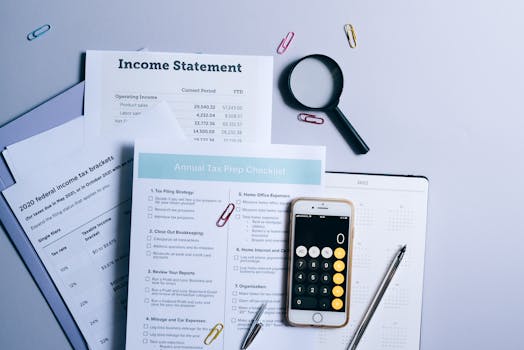
As we mentioned earlier, most countries allow certain business expenses to reduce taxable income. This is called a deduction. If you miss deductible items, you lose an easy, legal way to lower taxes.
Action steps
- By now, you already have your expenses identified from steps 1 and 2; use those as a reference.
- Review your expense list and mark items that relate directly to your business: software, supplies, home office portion of rent, professional services, subscriptions used for work, education, and business travel.
- If you have included expenses that do not match these criteria, chances are you won’t be able to use them to lower your tax base.
- Confirm rules in your country or region regarding timing and criteria to consider an item deductible.
- If you have expenses that don’t meet the criteria but could, take the time to fix that now. For example, if you require a receipt but don’t have it, try to get a copy where you made the purchase.
- Usually, expenses incurred before the calendar year-end count for that year. If you can make a qualifying purchase this month, do it now.
- For items that are partly personal and partly business, record a conservative split and keep a short note explaining the allocation.
- Review and adjust your total expenses based on the previous steps. For instance, if you conclude that an item is not deductible, eliminate it, or if you are able to include an additional purchase, add it.
Example
If a new laptop is needed for work and you were planning to buy one anyway, purchasing it before year-end can often mean that you claim it in the current tax year.
To learn more and complete your freelancer tax checklist you can visit
- Investopedia has a great series on this topic : (Click here)
- If you’re in the US, the IRS has some free resources you can consult: (Click here)
Once deductions are accounted for, you can estimate a more accurate taxable base figure.
Once your deductible expenses are locked in, it’s a great time to look at one more tax-saving opportunity: your retirement contributions.
4. Make One Retirement Contribution If Applicable
Why it matters
Saving and investing for the long term builds financial security, especially when those savings will fund your retirement. Since you are already supposed to be saving for retirement, the fact that many countries allow you to use your tax contributions to lower your taxes is great.
Depending on your situation, retirement contributions may be tax-exempt now or taxed later when you withdraw them, either way, you benefit.
Why now
Many retirement or pension accounts accept contributions up to the end of the calendar year. A single contribution can reduce your tax base. As we mentioned earlier, this will not only lower taxes but will help your future be more financially secure.
Action steps
- You should be prioritizing retirement, and if you already have a savings goal, great. Just check if in your country there are retirement accounts that offer tax benefits and get one if you don’t already have one.
- If you are not actively saving for retirement and are trying to close the year as best as possible, that’s ok. Check if you have available cash to put toward retirement. If your income minus your expenses results in a positive number, you probably do, but double-check.
- In either case, if you have a retirement option for independent workers in your country, review contribution rules and deadlines. Contribute if it makes sense for cash flow and tax planning.
- If you are unsure, prioritize research. Most countries provide free and widely available information. Plus, financial institutions that offer these kinds of accounts will have people available to offer you guidance.
Some tips for your research regarding retirement accounts
- This is your money for retirement. You can’t afford to lose it, so do good research.
- There are only a few weeks left in the year, so you are working with a tight timeline. Prioritize reputation and safety over profitability. You can always change your account or open a new one next year if you find a better option.
- Do a little window shopping and visit three to five providers that offer these types of accounts. This will not only help you choose one but will give you information about the relevant features.
- Make a list of your main concerns and ask them. Some examples are: Are there special accounts for freelancers? How can I be sure it will qualify to lower my taxes? How long do I need to leave my money locked in? What happens if I need my money earlier? How will my money be invested? What has been the average profitability of this kind of account in the last year, 5-year, and 10-year period?
Retirement contributions are long-term and reduce tax stress now and in the future.
With your retirement contributions handled, let’s make sure you’re financially ready for what comes next: paying the actual tax bill.
5. Estimate What You May Owe and Set Aside the Cash

Why it matters
Freelancers who wait until the filing deadline are often surprised. Estimating now prevents cash shortfalls and high stress later.
The last thing you want is to lock up your cash in a retirement account, or spend it on holiday cheer, only to realize you don’t have enough left to pay your taxes.
Yes, retirement savings are important and a great way to lower your taxes but make sure your cash flow can handle locking that money away long term.
Action steps
- Use your organized income minus deductible expenses to estimate your taxable profit. Apply a conservative tax rate to that number to estimate liability. If you are unsure of the rate, use a conservative assumption, such as 20 to 30 percent, and adjust once you confirm local rates.
- Put that estimated amount into a dedicated savings account. Treat it as untouchable money until you finalize actual tax calculations. If you don’t have the money, start saving it.
- If you make quarterly estimated payments in your country, check whether another payment is due soon and plan ahead. These payments usually count as prepaid taxes, so subtract what you’ve already paid from your estimate.
Example
If you estimate that you will owe $6,000, put $500 per month aside for the next 12 months or the remainder needed before the filing date. If you have only two months, prioritize setting aside a larger portion now.
Having a tax reserve reduces worry and prevents you from selling investments, using your emergency fund, or getting into debt at the worst possible time.
Bottom line: knowing you can pay your taxes means peace of mind later.
6. Review Your Cash Flow for the Rest of the Year
Taxes are a result of your business. So, even though it doesn’t feel great to pay them, having to do so is usually a good sign that your business is generating profit.
But profit isn’t the same as cash flow (click here if you want to dig into the difference). Make sure your business is strong on both fronts, so you can cover purchases, make contributions, and meet your tax payments comfortably.
What can you do:
- Check if you have outstanding payments from clients (unpaid invoices). If you do, politely remind your clients.
- Check if there are any invoices you haven’t sent yet: maybe you forgot, or your client hasn’t given you the final approval.
- Check if you’re still paying for unnecessary expenses, like subscriptions you don’t use. It’s pointless that this is deductible from taxes if you don’t get any value from it. Cancel them to start the year without this burden.
- If you don’t have an emergency fund, start one, even if at first it is not very big. This will give you a sense of safety and will buy your business some time when obstacles arise.
- Set aside some time to plan for next year; this will give you clarity to make better decisions.
Once your cash flow is clear, you’ll have a solid foundation to finish the year strong and start the next one with less stress.
Final Thoughts about your freelancer tax checklist
You don’t need to fix everything at once. But the year is ending, and tax season isn’t something you can avoid. Avoiding this reality won’t get you anywhere. Instead, make a quick list of what resonated with you from this post. Those are the critical issues to focus on first. Identify reasonable actions you can take to start and address them. Start by committing to setting aside 30 minutes this week to start working on these issues.
Save this freelancer tax checklist for next year to stay ahead. You’ll thank yourself when tax season arrives and you feel calm, prepared, and confident.