Freelancers & Entrepreneurs

Managing irregular income, taxes, and small business finances.

Stress Free Freelancer Tax Checklist: Year-End Tips 2025

Freelancer Tax Checklist: Avoid Year-End Stress

Freelancer tax checklist

Freelancers, Don’t Let Tax Season Sneak Up Again

It’s just a few weeks before 2025 ends. A lot happens this time of year, and it can feel overwhelming. You’re juggling clients, deadlines, and plans for next year, but that can’t be an excuse to put your business finances on the back burner.

These last few weeks could be your final chance to take action with your freelancer tax checklist, avoid overpaying taxes, and skip the nasty surprise when tax season arrives.

You’ve worked hard all year to build your income and independence. The last thing you want is to let taxes undo your progress. There are two main reasons that can happen.

The first reason is simple: it’s money. You may end up paying more taxes than you need to just for being disorganized, not keeping proper records, or just not understanding how taxes work.

The second reason is time. You want to be able to be as focused as possible on your business; after all, you are the one who makes it work. But if tax season comes and you’re unprepared, it will take a lot of your time and will be an incredible source of stress.

If you take a few clear steps before the end of the year, you will reduce stress, avoid last-minute scrambles, and have a much better read on your money.

This freelancer tax checklist is based on general principles and aims to let you see what you may be missing. While taxes differ by country and situation, some basics apply everywhere. Use the steps below to organize records, lock in deductible expenses, estimate what you owe, and create a small cash buffer so you start 2026 with less financial worry.


How to Use This Freelancer Tax Checklist.

Read this freelancer tax checklist once now. Identify the points where you need to work and start with the most time-sensitive. Remember, you only have until the end of the year.


1. Find Out Where You Stand

A woman's hand pointing at a location on a world map inside a car, highlighting navigation and travel planning.

What you need to know

As a freelancer, taxes depend on your income. In most countries, you can subtract certain expenses to find your tax base: the number used to calculate your taxes. You may even be able to include your contributions to pension plans.

Why do you need to know it?

You don’t want 2026 tax season to come along and find out you missed the opportunity to legally and rightfully include an expense or a retirement contribution for the calculation of your taxes. It will be too late by then.

What’s the problem?

You can’t think about your tax base if you don’t have a clear picture of how 2025 looks so far:  your income, your expenses, and what’s still coming in. Ideally, you will have all your records organized (which we’ll talk about later), and it will be easy for you to find this information, but even if it isn’t, try to get some rough estimates.

Why a rough estimate?

You don’t have much time before the year ends, and gathering all your records can take a while. It might be a lot of information, require help from a third party, or just feel so boring and daunting that you put it off.

What to do?

Try to figure out two key numbers as quickly as you can, even if roughly: your income for the year (including a quick estimate for the last few weeks) and your total business expenses. A reference for your tax base will be the difference between your income and your expenses.

Once you have those rough numbers, it’s time to back them up with solid, organized records.


2. Gather and Organize Your Records

Colorful folders and pen arranged on a wooden table for office organization.

Why it matters

This step is a continuation of the previous one. In the first step, you created a point of reference. Now we’ll go deeper with two goals:

  • Make sure we didn’t miss anything from our rough estimate.
  • Have all the supporting papers (digital papers, that may be) that the tax authority could ask for.

You cannot estimate taxes, claim deductions, or see your real profit if your paperwork is scattered. A quick, consistent system saves hours later.

Action steps

  • Pull every invoice, receipt, bank statement, and payment record for the year into one folder. Digital folders are fine. Use a naming system like 2025_ClientName_Invoice, it makes searching and sorting easier later.
  • If you have paper receipts, scan or photograph them now and add the images to the folder.
  • Make a single spreadsheet or simple bookkeeping file with columns: date, client, amount, category (income, expense type), and notes. Even a basic sheet gives immediate clarity.
  • Add total income and total expenses. Do they match your initial estimate?

See our resource section

See our resource section

Click here to change see our free budget template and other resources.

Example

Try organizing your digital folders by month (January to December), and inside each month create one folder for income and another for expenses. You can add more categories if needed. Just remember that too many folders can be hard to keep organized and make files tougher to find later.

With organized records, you can now be sure of the two numbers that matter: how much you earn (income) and how much you spent (expenses). If this matches your rough estimate, it’s great. If not, try to find the difference, start with the biggest items and work your way down.

With your records in order, you’re ready to make sure you’re not missing any tax-deductible opportunities.


3. Identify Deductible Expenses and Lock Them In

An organized desk with tax documents, checklist, and gadgets for tax preparation.

Why it matters

As we mentioned earlier, most countries allow certain business expenses to reduce taxable income. This is called a deduction. If you miss deductible items, you lose an easy, legal way to lower taxes.

Action steps

  • By now, you already have your expenses identified from steps 1 and 2; use those as a reference.
  • Review your expense list and mark items that relate directly to your business: software, supplies, home office portion of rent, professional services, subscriptions used for work, education, and business travel.
  • If you have included expenses that do not match these criteria, chances are you won’t be able to use them to lower your tax base.
  • Confirm rules in your country or region regarding timing and criteria to consider an item deductible.
  • If you have expenses that don’t meet the criteria but could, take the time to fix that now. For example, if you require a receipt but don’t have it, try to get a copy where you made the purchase.
  • Usually, expenses incurred before the calendar year-end count for that year. If you can make a qualifying purchase this month, do it now.
  • For items that are partly personal and partly business, record a conservative split and keep a short note explaining the allocation.
  • Review and adjust your total expenses based on the previous steps. For instance, if you conclude that an item is not deductible, eliminate it, or if you are able to include an additional purchase, add it.

Example

If a new laptop is needed for work and you were planning to buy one anyway, purchasing it before year-end can often mean that you claim it in the current tax year.

To learn more and complete your freelancer tax checklist you can visit

  • Investopedia has a great series on this topic : (Click here)
  • If you’re in the US, the IRS has some free resources you can consult: (Click here)

Once deductions are accounted for, you can estimate a more accurate taxable base figure.

Once your deductible expenses are locked in, it’s a great time to look at one more tax-saving opportunity: your retirement contributions.

4. Make One Retirement Contribution If Applicable

Why it matters

Saving and investing for the long term builds financial security, especially when those savings will fund your retirement. Since you are already supposed to be saving for retirement, the fact that many countries allow you to use your tax contributions to lower your taxes is great.

Depending on your situation, retirement contributions may be tax-exempt now or taxed later when you withdraw them, either way, you benefit.

Why now

Many retirement or pension accounts accept contributions up to the end of the calendar year. A single contribution can reduce your tax base. As we mentioned earlier, this will not only lower taxes but will help your future be more financially secure.

Action steps

  • You should be prioritizing retirement, and if you already have a savings goal, great. Just check if in your country there are retirement accounts that offer tax benefits and get one if you don’t already have one.
  • If you are not actively saving for retirement and are trying to close the year as best as possible, that’s ok. Check if you have available cash to put toward retirement. If your income minus your expenses results in a positive number, you probably do, but double-check.
  • In either case, if you have a retirement option for independent workers in your country, review contribution rules and deadlines. Contribute if it makes sense for cash flow and tax planning.
  • If you are unsure, prioritize research. Most countries provide free and widely available information. Plus, financial institutions that offer these kinds of accounts will have people available to offer you guidance.

Some tips for your research regarding retirement accounts

  • This is your money for retirement. You can’t afford to lose it, so do good research.
  • There are only a few weeks left in the year, so you are working with a tight timeline. Prioritize reputation and safety over profitability. You can always change your account or open a new one next year if you find a better option.
  • Do a little window shopping and visit three to five providers that offer these types of accounts. This will not only help you choose one but will give you information about the relevant features.
  • Make a list of your main concerns and ask them. Some examples are: Are there special accounts for freelancers? How can I be sure it will qualify to lower my taxes? How long do I need to leave my money locked in? What happens if I need my money earlier? How will my money be invested? What has been the average profitability of this kind of account in the last year, 5-year, and 10-year period?

Retirement contributions are long-term and reduce tax stress now and in the future.

With your retirement contributions handled, let’s make sure you’re financially ready for what comes next: paying the actual tax bill.


5. Estimate What You May Owe and Set Aside the Cash

Fan of US $100 bills partially out of a white envelope on a white background.

Why it matters

Freelancers who wait until the filing deadline are often surprised. Estimating now prevents cash shortfalls and high stress later.

The last thing you want is to lock up your cash in a retirement account, or spend it on holiday cheer, only to realize you don’t have enough left to pay your taxes.

Yes, retirement savings are important and a great way to lower your taxes but make sure your cash flow can handle locking that money away long term.

Action steps

  • Use your organized income minus deductible expenses to estimate your taxable profit. Apply a conservative tax rate to that number to estimate liability. If you are unsure of the rate, use a conservative assumption, such as 20 to 30 percent, and adjust once you confirm local rates.
  • Put that estimated amount into a dedicated savings account. Treat it as untouchable money until you finalize actual tax calculations. If you don’t have the money, start saving it.
  • If you make quarterly estimated payments in your country, check whether another payment is due soon and plan ahead. These payments usually count as prepaid taxes, so subtract what you’ve already paid from your estimate.

Example

If you estimate that you will owe $6,000, put $500 per month aside for the next 12 months or the remainder needed before the filing date. If you have only two months, prioritize setting aside a larger portion now.

Having a tax reserve reduces worry and prevents you from selling investments, using your emergency fund, or getting into debt at the worst possible time.

Bottom line: knowing you can pay your taxes means peace of mind later.


6. Review Your Cash Flow for the Rest of the Year

Taxes are a result of your business. So, even though it doesn’t feel great to pay them, having to do so is usually a good sign that your business is generating profit.

But profit isn’t the same as cash flow (click here if you want to dig into the difference). Make sure your business is strong on both fronts, so you can cover purchases, make contributions, and meet your tax payments comfortably.

What can you do:

  • Check if you have outstanding payments from clients (unpaid invoices). If you do, politely remind your clients.
  • Check if there are any invoices you haven’t sent yet: maybe you forgot, or your client hasn’t given you the final approval.
  • Check if you’re still paying for unnecessary expenses, like subscriptions you don’t use. It’s pointless that this is deductible from taxes if you don’t get any value from it. Cancel them to start the year without this burden.
  • If you don’t have an emergency fund, start one, even if at first it is not very big. This will give you a sense of safety and will buy your business some time when obstacles arise.
  • Set aside some time to plan for next year; this will give you clarity to make better decisions.

Once your cash flow is clear, you’ll have a solid foundation to finish the year strong and start the next one with less stress.


Final Thoughts about your freelancer tax checklist

You don’t need to fix everything at once. But the year is ending, and tax season isn’t something you can avoid. Avoiding this reality won’t get you anywhere. Instead, make a quick list of what resonated with you from this post. Those are the critical issues to focus on first. Identify reasonable actions you can take to start and address them. Start by committing to setting aside 30 minutes this week to start working on these issues.

Save this freelancer tax checklist for next year to stay ahead. You’ll thank yourself when tax season arrives and you feel calm, prepared, and confident.

Stress Free Freelancer Tax Checklist: Year-End Tips 2025 Read More »

5 Proven Financial Basics Every Freelancer Should Know for Lasting Success

5 Proven Financial Basics for Freelancers (and Why They Matter)

Learn 5 key money concepts, from revenue to cash runway, to manage your freelance or small-business finances with confidence

Freelancing or starting a business is an exciting opportunity, but it also comes with plenty of challenges. Understanding a few essential financial concepts can make those challenges easier to handle, which is why we’ve prepared these 5 financial basics every freelancer should know.

Whether you’ve just started freelancing or have been in business for a while, you’ve probably realized that managing cash flow along with meeting legal, accounting, and tax obligations, can be stressful, time-consuming, and costly. These demands can easily pull your focus away from the work you love.

At Money Map Lab (MML), we believe money should work for you, not the other way around. Learning these 5 financial basics for freelancers is a great first step toward that goal:

  • Revenue vs. Profit
  • Profit vs. Cash flow
  • Tax base vs. Tax Shield
  • Financial Indicators
  • Burn Rate vs. Cash Runway

You don’t need to be a financial expert to run your business, but we all deal with money and money comes with its own language. The following ideas aren’t just definitions; they’re general concepts that will help you feel more confident and better equipped to manage your finances.

Financial basics for freelancers

Final basics for freelances #1: Revenue vs. Profit

In the early stages, most business owners focus on generating revenue, deciding what to offer, finding clients, and getting paid. After all, revenue is the lifeblood of any business, which is why we’ve included it in this list of financial basics for freelancers.

Revenue is the total amount of money your business earns from selling products or services.

“Revenue is the money generated from the sale of a company’s products or services.”
U.S. Chamber of Commerce

Examples of revenue:

  • If you sell popsicles, your revenue is the number of popsicles sold multiplied by the price of each.
  • If you sell a membership, your revenue equals the number of subscribers multiplied by the membership fee.
  • If you offer consulting services, your revenue is the flat fee you charge each client.
  • If you’re an attorney charging by the hour, your revenue is your hourly rate multiplied by billable hours.

However, you don’t get to keep all your revenue. You still need to cover costs, anything required to produce, market, and manage your business.

Examples of expenses:

  • Popsicle maker? You’ll need clean water, flavorings, and cold storage.
  • Membership site? You’ll pay for the hosting platform and digital materials.
  • Consultant? You might need office space or travel funds.
  • Attorney? Office rent, software, and database subscriptions add up.

Profit is what remains from revenue after you subtract those costs or expenses.

“Profit is money that is earned in trade or business after paying the costs of producing and selling goods and services.”
Cambridge Dictionary

For accounting and financial purposes, you can identify different types of profit depending on what you want to measure or track in your business. Each type provides specific insights into how your business is performing and where your money is going, which is why they are relevant money concepts for freelancers.

Types of profit:

  • Gross Profit: Revenue minus direct production or service delivery costs.
  • Operating Profit: Gross profit minus administrative and sales expenses.
  • Net Profit: Profit after income tax.

So, while generating revenue is important, especially for freelancers and business owners seeking stability, it’s not the whole picture. Focusing only on revenue can leave you exhausted and with little to show for your hard work.

Imagine you run a catering business and regularly bill a client $3,000, that’s your revenue. But if you spend $2,700 on ingredients, transportation, and packaging, your profit is only $300.

Financial basics for freelancers # 1: Start thinking about profit, not just revenue.

Before submitting a proposal, estimate how much it will actually cost you to deliver the product or service, including the value of your own time. For ongoing projects, make sure you regularly track both income and expenses so you can see where your money is really going.

👉 You can download our Freelance Expense Tracker [Here].


Final basics for freelances #2: Profit vs. Cash Flow

At first glance, profit and cash flow might seem similar, but they measure very different things.

Profit shows whether your business is making or losing money during a period.
Cash flow shows the movement of money in and out of your business at any point in time.

“Cash flow refers to the net balance of cash moving into and out of a business at a specific point in time.”
Harvard Business School Online

A person holding a fan of US dollar bills, symbolizing wealth and financial success.

Key differences:

  • Timing: Profit reflects income and expenses when they’re earned or incurred. Cash flow reflects when the money moves.
    Example: If you sell $2,000 worth of popsicles today but give your client 30 days to pay, you’ve earned $2,000 in revenue today but you won’t have a cash inflow until next month.
  • Execution: Business isn’t always perfect. If a client doesn’t pay (or you delay paying a supplier), your profit might look fine, but your cash flow could be negative.
  • Accounting: Some accounting rules require recording non-cash items, like asset depreciation. That affects profit but not your actual cash.

Suppose you invoice a client for $3,500 today, but they take 45 days to pay you. Meanwhile, you still need to pay yourself (for rent, food, and everyday expenses), your suppliers, and any software or tools you use. So, while your business might show a profit that month, the time it takes for money to actually reach your bank account still matters.

To avoid cash flow issues, set clear payment terms with your clients, request advance payments when possible, and use reminders or automated tools to follow up on invoices.

Knowing your profit gives you insight into the sustainability of your business, is your revenue enough to cover all your costs and expenses?

Understanding cash flow, on the other hand, helps ensure your business can actually stay afloat day to day.

Remember, it’s possible to be profitable and still run out of money, just as it’s possible to be unprofitable and still have cash. Understanding this distinction helps ensure you don’t confuse being “profitable” with being “financially stable” and that is why it’s part of mastering the financial basics for freelancers.

Final basics for freelances #3:Tax Base and Tax Shield

Once you grasp revenue and profit, it’s time to look at taxes.

Taxes can significantly impact your results, and as a freelancer or business owner, you’re responsible for providing accurate information to your accountant or tax preparer. While every country and region has its own rules and they are updated often, it helps to understand two key ideas:

Tax Base

The tax base is the value over which your taxes are calculated. Depending on the type of tax, this could be your profit, your revenue, or the value of an asset.

Examples:

  • VAT (Value Added Tax): Calculated on sales.
  • Income Tax: Calculated on profits.

For details on your country’s rules, always check local tax laws, since they may differ from general accounting definitions.

Tax Shield

A tax shield refers to items that reduce your taxable income (and therefore your taxes).
Common examples include:

  • Interest expenses from loans, which reduce profits.
  • Depreciation of assets, which lowers your taxable base.

Knowing about tax shields helps you make smarter financial decisions; for example, deciding whether taking out a loan or investing in equipment might offer tax advantages. For instance, a new laptop can be depreciated, meaning part of its cost is recorded as an expense each year, which reduces both your profit and your tax base.

Remember, even if you hire someone to handle your taxes, it’s still your business and ultimately, you’re the one responsible for any mistakes. So don’t just outsource; take time to understand the main issues and meet with your accountant regularly to review your numbers.

You can learn more about the concepts of tax base and tax shield in this Investopedia article


Financial basics for freelancers #4: Financial Indicators

Financial indicators are metrics that show how healthy your business really is. There are many to choose from, but you don’t need to track them all. Start with just a few key ones to gain insight and make informed decisions.

Close-up of hand pointing at finance report with charts and graphs on paper.

Useful indicators include:

  • Margins: Profit ÷ Revenue
    Shows what percentage of your revenue you keep after costs. Use gross, operating, or net profit depending on what you’re analyzing.
  • Revenue Efficiency: Helps you understand how effectively you generate income.
    Examples:
    • Hourly rate: Revenue ÷ hours worked
    • Average ticket: Revenue ÷ total transactions
    • Revenue growth: Compare revenue between periods
  • EBITDA: Earnings Before Interest, Taxes, Depreciation, and Amortization.
    This is a quick and common way to approximate your business’s cash-generating ability before accounting for non-cash expenses.

These numbers might sound technical, but once you start tracking them monthly, they become powerful tools to make smarter business decisions. Just choose one or two that seem relevant for your business.

Tracking these numbers regularly gives you valuable insight into whether your business model is sustainable and helps you identify areas of improvement, and thats how these financial basics for freelancers turn into a powerful tool.


Financial basics for freelancers # 5: Burn Rate and Cash Runway

These two terms are popular in startup culture, but they’re just as useful for freelancers and small businesses.

sparks, fire, burns
  • Burn Rate: The amount of cash your business spends over a specific period (month, quarter, etc.) to keep running.
    → Ask yourself: How much money do I need each month to stay afloat?

Knowing your burn rate is a good sign that you truly understand your business. Start by writing down all your monthly expenses so you have them clearly identified. Then, track them regularly to make sure your expectations match reality.

You can use our free budget template to get started, try a more comprehensive version with a built-in tracker on Etsy, or use an accounting tool like QuickBooks to automate the process.

Check out our Free and Paid Resourses

In this link you’ll find our Free budget template and our Etsy Store Link to continue mastering the financial basics for freelancers.

You can calculate Gross Burn rate which are your total cost and expenses or Net burn rate, which includes your income. It depends on what you want to track.

You can learn the difference between gross and net burn rate Here.

  • Cash Runway: The number of months your business can continue operating with the cash you have on hand.
    → For example, if you have three months of runway left, you might look for ways to cut expenses or generate new income before you run out.

To calculate, divide your business savings by your burn rate and aim to 3 to 6 months: you can read more on this on our article Freelance Money Management: 7 steps to Stress-Free Finances.

Knowing both numbers gives you early warning signals so you can take action before a financial crunch hits, and that is how you get the most out of these financial basics for freelancers.


Conclusion

There you have five essential financial concepts every freelancer and small business owner should understand.

Mastering these financial basics for freelancers isn’t about turning you into a financial expert; it’s about giving you confidence and control. When you understand how revenue, profit, cash flow, taxes, and key indicators work together, you can make smarter choices, communicate clearly with accountants and clients, and build a business that lasts.

Financial knowledge is power and the more you know, the more freedom you’ll have to shape the business (and life) you want.

Start organizing your personal and business finances with our free budget template.

Check out our Free and Paid Resourses

In this link you’ll find our Free budget template and our Etsy Store Link to continue mastering the financial basics for freelancers.

5 Proven Financial Basics Every Freelancer Should Know for Lasting Success Read More »

The Ultimate Guide to the Gig Economy: 5 Key Ways Freelancers, Solopreneurs, and Entrepreneurs Fit In

What Is the Gig Economy? A Guide for Freelancers, Solopreneurs, and Entrepreneurs

You’ve probably noticed more people talking about freelancing, side hustles or entrepreneurship lately. From driving for apps to running one person consultancies, work today is looking less like the traditional 9-to-5 and more like a flexible patchwork of independent income streams.

That shift has a name: the gig economy. But what does it really mean  and how do you know whether you’re part of it?


Understanding the Gig Economy

Let’s start with the basics. The term “gig economy” is built from two familiar words:

  • Gig: “A job that is temporary, does not offer many hours, or may end at any time, usually involving working for yourself rather than for an employer.” [1]
  • Economy: “The system of trade and industry by which the wealth of a country is made and used.” [2]
Gig economy freelancer A cheerful woman sitting outdoors, celebrating success with arms raised, while using a laptop.

Now let’s look at how reputable organizations define it:

  • The World Economic Forum (quoting the UK government) defines the gig economy as: “the exchange of labour for money between individuals or companies via digital platforms that actively facilitate matching between providers and customers, on a short-term and payment-by-task basis.” [3]
  • The consulting firm McKinsey & Company says: “The gig economy refers to the workforce of people engaged in freelance and side-hustle work.” [4]
  • The International Labour Organization (ILO) adds: “In the gig economy, workers are typically self-employed or independent contractors, rather than being employed by a company.” [5]

Despite the differences in wording, these definitions share a core idea: independence. Gig workers are not tied to a single employer, they choose their projects, clients, and schedules.

While platforms like Fiverr or Upwork make this easier, independent work doesn’t have to happen online. Old-fashioned networking, referrals, and social media are just as effective in connecting providers and clients.

In short: The gig economy is the generation of income through independent relationships between service-providers and customers, rather than through traditional employment.

Get our Free Budget Template

No matter where you are in your financial journey, a good budget can make everything simpler.

Why It Matters (and the Big Picture)

Here are a few things that help show why the gig economy matters now:

What this means for you (yes, you!) is that the tools and opportunities to work independently are more accessible than ever but so are the responsibilities and challenges. It’s less about being a good worker and more about being in charge of finding and delivering your own work.

Gig economy apps. A bicycle with a delivery bag poised for service in a modern urban environment.

The Pros and Cons of the Gig Economy

Whether you’re a worker, a company, or a policymaker, the gig economy offers both opportunities and challenges. Let’s break them down realistically.

Pros of the Gig Economy

1. Efficiency


For companies, hiring freelancers or contract workers can be faster and more cost-effective than onboarding full-time employees. For workers, it can open access to global opportunities and diverse projects that wouldn’t exist locally.

2. Flexibility


Setting your own hours can be life-changing. You might pick your kids up from school, work out during quiet hours, or travel in the off-season months. Independent work fits into your life, rather than the other way around.

3. Income Potential


In theory, the sky is the limit. Unlike traditional employment (where you might trade time for money and hand over ownership of your creations), independent workers often retain partial ownership of their creations and can serve multiple clients.

With experience and scalability, you can meaningfully grow your income.

Cons of the Gig Economy

1. Lack of Stability


A full-time job often comes with a steady paycheck, benefit structures, defined routines and a support system of co-workers. Independent workers must build their own systems, find clients, and manage uncertainty month to month.

2. Hidden Costs


Tools, workspace, software, tax preparation, health coverage, many of these become your responsibility. On the corporate side, companies that rely heavily on gig workers may face hidden costs such as lack of long-term institutional knowledge or weaker team cohesion.

3. Stress and Burnout


The freedom of being your own boss can mask the pressure of constantly securing the next project. Research shows that many gig workers face irregular income and lower job protections. [7]

Who’s Part of the Gig Economy?

Let’s map out who fits into this space and who doesn’t.

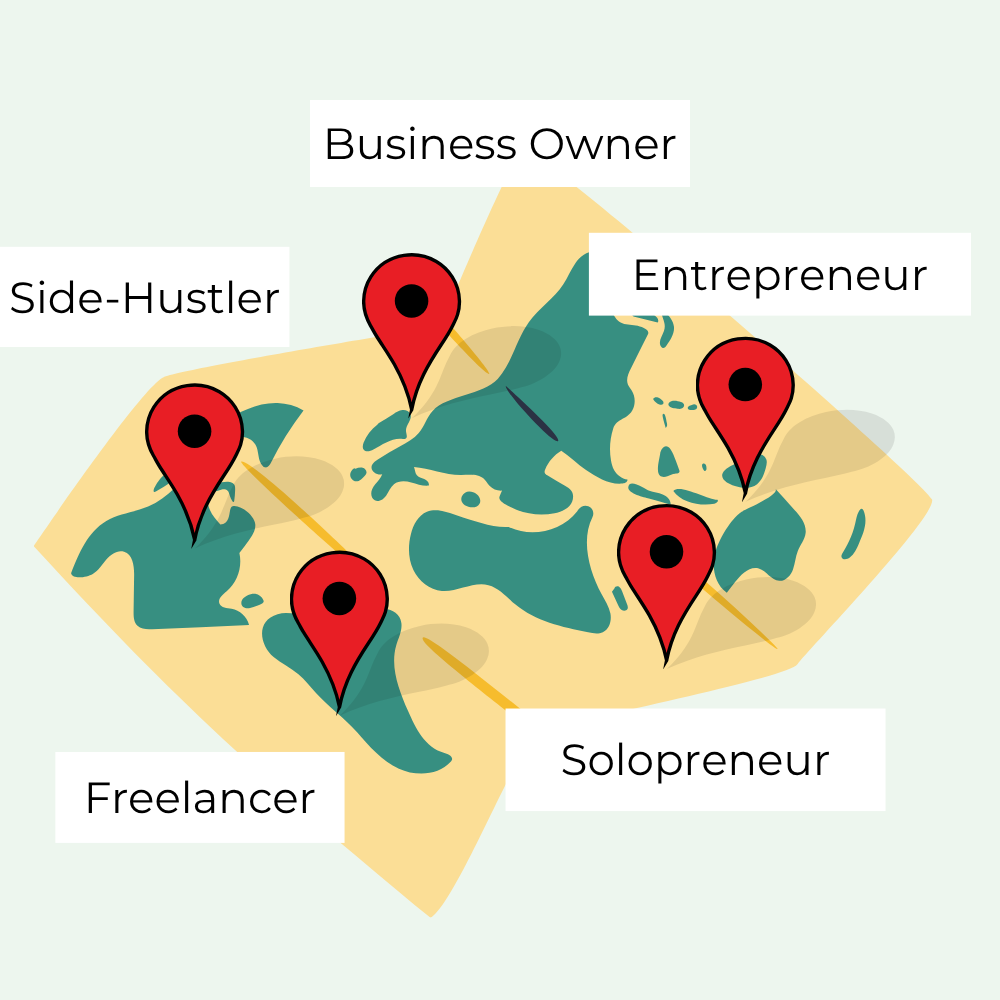
The Gig Economy Map

Side Hustlers

People who earn extra income outside their main job. Maybe you still work full-time, but you design websites on weekends or sell products online.

According to HustlersLibrary.com, a side hustle is: “any type of work or business you pursue in addition to your primary source of income. It allows flexible hours and control over rates, anything from freelance writing to selling crafts online.”

Freelancers

Self-employed professionals who deliver services to multiple clients, often on short-term contracts. Think of designers, writers, developers, consultants who trade expertise for flexibility and variety.

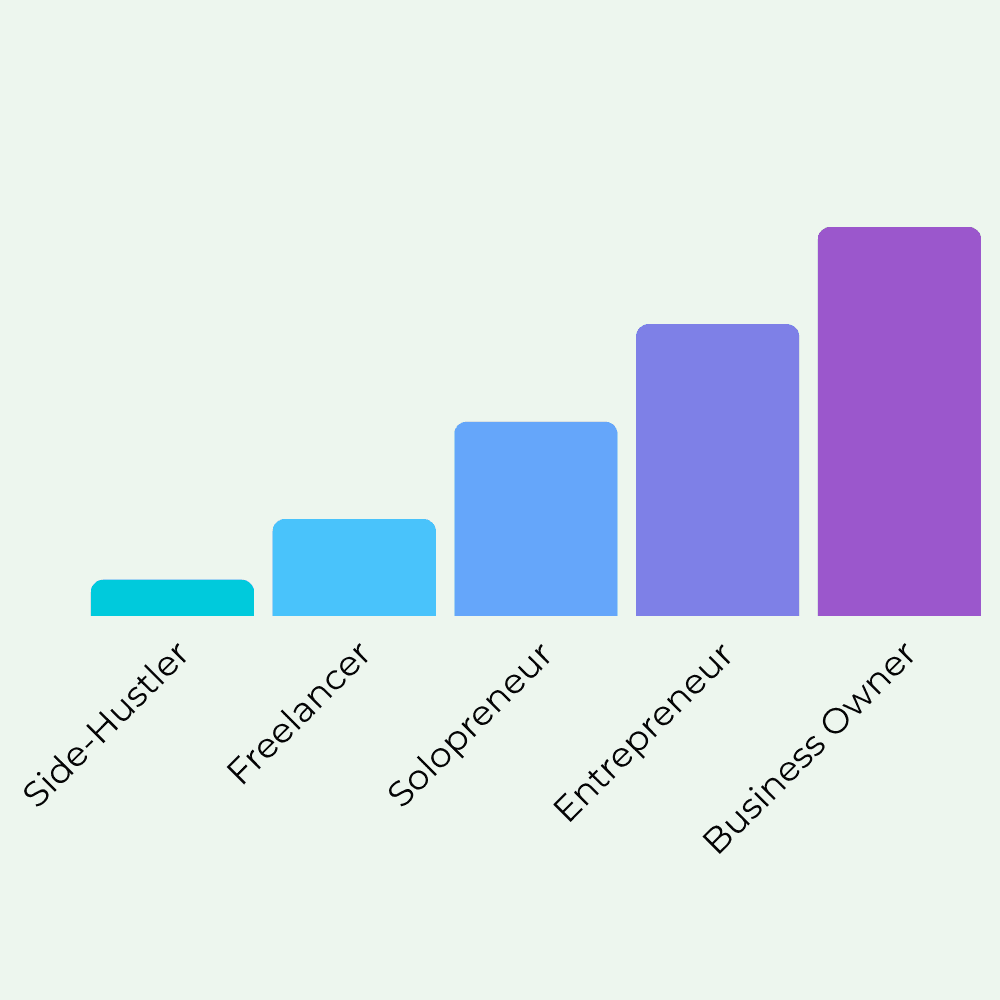
Who May Be Part of the Gig Economy (and transition toward something bigger)

If you’re thinking longer term, beyond the “project-to-project” hustle, you may fit into these broader categories.

Solopreneurs

A solopreneur runs a business entirely on their own. They don’t just deliver work, they also handle marketing, sales, customer service, systems. They’re building something lasting, even if they’re still a one-person team.

“A solopreneur is an individual building and running a business on their own without any employees. They handle every aspect of the business including delivering the work, marketing, and customer service” [8]

Entrepreneurs

Entrepreneurs see opportunities, build teams, scale solutions. They don’t just pick up the next project,they build a business that operates beyond them.

“An entrepreneur is someone who sees a business opportunity and takes action to realize their vision. They are typically innovative problem solvers and are not afraid to take risks to start new ventures and create wealth. While there are no strict rules around the qualities of an entrepreneur, they are usually associated with developing new products or innovations.”[9]

Who Isn’t Part of the Gig Economy?

  • Traditional Employees: People with medium- or long-term contracts, working for a single employer with less independence. They lack the flexibility and non-traditional structure that define the gig economy.
  • Established Business Owners (scaling beyond freelancer/solopreneur): While they may have independence, their goal is stability and growth—so they’re somewhat outside the “gig” framing.

Making the Most of the Gig Economy: Practical Steps

If you’re intrigued by this route, here are actionable ways to navigate and optimize your path in the gig economy.

Step 1 – Clarify your goals.


What do you want from this working-style? Is it a side income for now, a flexible full-time alternative, or the start of a business? Having that clarity helps shape how you behave.

Step 2 – Pick a skill and build credibility.

Figure out what you’re offering. Ideally, it’s something you already know how to do but if it’s not find a way to learn it.  Build a physical (meet local business owners, attend events and conferences, reach out to friends and acquaintances) and digital presence (LinkedIn, personal website, platform profile). Gather experience and build a network. Over time, you’ll become known for more than just “any freelance work.”

Step 3 – Diversify clients and income streams.


Relying on one client is risky. Figure out your capacity and ways to improve it. If possible, aim for more than one client or combine project-work with perhaps a subscription or retainer model. That builds stability.

Step 4 – Invest in systems and skills.

As you grow, the “business” part becomes important: invoices, contracts, tax budget, marketing, CRM. Learn simple business basics and figure out how to handle them. From virtual assistants to accounting software, today it is cheaper than ever to outsource administrative work.

Step 5 – Manage the downside.

Freelancing or any gig-based works requires organization. Budgeting, setting an emergency fund and separating personal and business expenses becomes relevant.  

You may be interested in MML post: Freelance Money Management: 7 Steps to Stress-Free Finances

Step 6 – Think long term.

If you like independence and flexibility, consider how you might evolve: Could you scale by hiring someone? Build a product? Create recurring revenue (e.g., online course, membership)?

Even if your goal is simply flexible income, it’s useful to think 3-5 years ahead: Where will you be? What do you want your work-life to look like?

Real-World Anecdotes & Trends

Trend 1:

Younger workers are leading the charge. Many in Gen Z and Millennials prefer project-based, flexible work over traditional careers.[10]

Trend 2:

Remote, online gig work has made global talent a reality: you can live in Europe and work for a client in the US, for example.

Trend 3:

Growth in developing countries is especially rapid, digital gig work opens new markets for women and youth who may have lacked opportunities in formal employment. [11]

Trend 4:

Conversion of gigs into businesses, many freelancers often evolve into solopreneurs or entrepreneurs once systems and clients are established (even unconsciously).[12]


pros, and, cons of the gig economy

Red-Flags & Things to Watch

While the gig economy offers opportunity, it’s not without challenges, for instance:

  • Low barriers to entry mean high competition. Without differentiation, it’s easy to end up racing to the bottom on price.
  • The “always-on” mindset, when you’re your own boss, you might feel you always need to hustle. But that can lead to burnout.
  • Lesser access to traditional protections (benefits, paid leave, maternity/paternity rights), many gig workers are responsible for their own safety nets.
  • Client concentration risk, if one big client leaves, it can dramatically impact your income.[13]
  • Difficulty separating personal and business life: from time to finances, you may find yourself having trouble differentiating where work ends and life begins.

How to Decide Where You Fit (and What’s Next)

Ask yourself:

  • Do I still have a primary job or am I fully independent?
    If you have a full-time job and you do separate projects on the side; you’re likely a side-hustler.
  • Am I delivering different projects for many clients without long-term commitments?
    That’s more freelancer territory.
  • Do I think of my work as a business and invest in systems, marketing, recurring revenue?
    That moves toward solopreneur.
  • Do I see building a team, product, and scaling beyond myself?
    That’s entrepreneur realm.
  • Do I own or manage a business with employees and independence from being the “doer”?
    That’s business owner territory, outside the core “gig economy” definition but definitely a logical next step.

By distinguishing where you are (and where you’d like to be), you can tailor your actions accordingly: skill-up, invest in systems, or diversify income.


The Takeaway: Independence Is a Journey

The gig economy isn’t a fad, it’s an evolution made more accessible by current technology. For many, it’s a bridge between traditional employment and long-term business ownership. While it brings uncertainty, it also opens doors to freedom, creativity and control over your time, opportunities and finances.

Whether you’re freelancing after hours or dreaming of launching your own venture, remember: every “gig” is a step toward building the independent life you want, you just need to make a learning experience out of it.  Invest in yourself and give yourself time to learn all necessary skills. And let flexibility support you, rather than you constantly chasing work.

You’re not just doing random “jobs”, you’re choosing learning opportunities to deliberately shape your future.

The gig economy: Fromm side hustler to business owner

Get our Free Budget Template

No matter where you are in your financial journey, a good budget can make everything simpler.

[1] https://dictionary.cambridge.org/dictionary/english/gig

[2] https://dictionary.cambridge.org/dictionary/english/gig

[3] https://www.weforum.org/stories/2024/11/what-gig-economy-workers/

[4]https://www.mckinsey.com/~/media/mckinsey/featured%20insights/mckinsey%20explainers/what%20is%20the%20gig%20economy/what-is-the-gig-economy.pdf

[5] https://www.ilo.org/sites/default/files/2025-06/ILO%20-%20Mini%20Guide_%28Digital%29_13jun.pdf

[6] https://www.weforum.org/stories/2025/06/the-gig-economy-ilo-labour-platforms/

[7] https://www.ilo.org/sites/default/files/2025-06/ILO%20-%20Mini%20Guide_%28Digital%29_13jun.pdf

[8] https://www.uschamber.com/co/start/startup/what-is-solopreneur

[9] https://www.business.hsbc.uk/en-gb/insights/starting-a-business/what-is-an-entrepreneur

[10] https://www.intuit.com/blog/innovative-thinking/the-side-hustle-generation/

[11] https://blogs.worldbank.org/en/voices/promise-and-peril-online-gig-work-developing-countries

[12] https://www.entrepreneur.com/starting-a-business/from-side-gig-to-6-figure-success-how-i-built-a/482133

[13] https://www.freelancing.support/flightplan/task/understand-the-risks/

The Ultimate Guide to the Gig Economy: 5 Key Ways Freelancers, Solopreneurs, and Entrepreneurs Fit In Read More »

Mastering Freelance Money: 7 Easy Steps to Reduce Money Stress

Freelance Money Management: 7 Steps to Stress-Free Finances

“I didn’t decide I was crazy until 1952. That’s when I began making a steady salary and could afford to be crazy.”

When you’re a freelancer, you can’t afford to be careless with money. Unlike people in traditional jobs, you don’t receive a predictable paycheck every week or every month. Instead, your income depends entirely on you — your skills, your ability to find clients, and the work you deliver.

That freedom is exciting, but it also comes with a challenge: money stress. Because as a freelancer, your earnings need to cover both your personal cost of living and your business expenses. Some months will be great, others will be lean, and that unpredictability can feel overwhelming.

On top of that, freelancing means wearing many hats. You’re not just doing the work you’re hired for, but you’re also:

  • Sales & Marketing: finding new clients, upselling, networking.
  • Operations: delivering the actual service, whether it is design, coding, writing, consulting, you name it.
  • Customer Support: keeping clients happy, answering emails, following up.
  • Admin & Finances: handling invoices, expenses, taxes, and planning for the future.

It’s like being a one-person business. And without a system for managing your freelance finances, the stress can build quickly.

But here’s the good news: you can take control. With some simple strategies and a little discipline, you can reduce money stress, create stability, and set yourself up for long-term success.

This guide will walk you through 7 practical steps to master freelance money, so you can focus less on money worries and more on doing great work.

freelance money, laptop, workstaion, office, work, business, computer, writing, working, desk, notebook, blog, notepad, table, coffee, company, study, freelance, laptop, business, writing, writing, writing, writing, writing, blog, blog, blog, blog,

Step 1 – Map Out Your Personal Finances (Your Baseline)

Before you look at your freelance business numbers, you need to start with your own life. Why? Your freelance money should support your lifestyle, not the other way around. If you don’t know how much your life costs, you won’t know what your business needs to provide.

Here’s what to identify:

  • Monthly cost of living: rent or mortgage, food, insurance, utilities, savings, debt payments.
  • Emergency fund: if you don’t have one yet, aim for 6–12 months of expenses (freelancers face more income uncertainty).
“An emergency fund, also known as a rainy day fund, is a stash of easily accessible money that has been set aside for emergencies. Having money stashed away to deal with unexpected events can give you a sense of security—you’ll know that such an event won’t destroy or derail your financial plans.”
Finra Investor Education Foundation – Money Math for teens – The emergency fund
Tweet

To know more about how to built and emergency fund visit https://www.finrafoundation.org/sites/finrafoundation/files/2024-10/the-emergency-fund_0.pdfrg

  • Net worth: take stock of assets (house, car, savings) and liabilities (debts, loans).

Note: If you’re still building your emergency fund, make the monthly savings contribution a fixed line item in your budget, just like rent or groceries.

This first step is about clarity. Once you know your baseline, you’ll see exactly what your freelance income needs to cover.

Step 2 – Understand Your Freelance Money Snapshot

Now that you’ve clarified your personal finances, it’s time to do the same for your business. Remember: freelancing is not just “doing projects.” It’s a business and every successful business runs on knowing its numbers.

Start with income:

  • Look back over the last 12 months (or however long you’ve been freelancing).
  • Record your highest-earning month, your lowest, and your average monthly income.
  • Pay attention to the ups and downs, this shows how irregular your income is.

Then expenses:

  • List every recurring cost: coworking space, internet, software, subscriptions, equipment.
  • Include annual fees (divide them by 12).
  • Think about future replacements: laptops, furniture, tools. Add them as monthly savings goals.

Finally, cash flow:

  • Calculate income minus expenses (income – expenses)= cash flow.
  • Was it positive or negative overall?
  • Which months were profitable, and which weren’t?

This exercise may feel tedious, but it gives you a reality check. You’ll see what’s working, what’s draining your money, and where you need to adjust.

Note: Use your invoices, bank records, or PayPal history to gather data.

To learn more about cash flow you can read this post about cash -low

Get MML Free Budget Template

Get Your Free Budget Template — works for both personal and freelance finances + comes with simple PDF instructions.

Step 3 – Define Your Minimum Freelance Money Goal (Minimum Viable Income)

Now let’s connect Steps 1 and 2.

  • Step 1 showed you how much your life costs.
  • Step 2 showed you how much your business is making and spending.

Put them together, and you get your minimum viable income. This is  the monthly number your business must bring in to cover both personal and business expenses.

How to calculate it:

  1. Add your average monthly personal expenses (Step 1).
  2. Add your average monthly business expenses (Step 2).
  3. That total = your minimum viable income.

If your freelance business doesn’t meet that number consistently, you’ve got options:

  • Increase income (new clients, raising rates, offering add-ons).
  • Reduce expenses (cut unused subscriptions, work from home).
  • Consider temporary bridge work (such as part-time gigs or retainer projects) to stabilize income.

Note: Think of your minimum viable income as your “floor.” Everything above goes to savings, reinvestment and even the occasional treat.

Step 4 – Separate Personal & Business Finances

Here’s where many freelancers trip up. Mixing personal and business money makes it almost impossible to stay organized. It blurs the line between what you can spend and what you should save.

Here’s what to do:

  • Give yourself a salary. Decide how much to transfer from your business account to your personal one each month. This ensures you cover your personal needs without draining business funds. Make sure you consider the previous steps.
  • Open separate accounts. A business bank account is ideal, but even  a separate digital account (such as Wise, PayPal, or Revolut) is a good start. Having separate personal and business accounts will make day-to-day mechanics easier, from getting information to taxes, to providing clients and suppliers with relevant insights.
  • Consider a legal entity. Depending on where you live, an LLC or similar structure might protect you legally and help with taxes, do some research and ask an expert.

Separating money does three things:

  1. Protects your business cash for reinvestment or slow months.
  2. Simplifies taxes and bookkeeping.
  3. Shows you clearly whether your business really supports your lifestyle.

For more practical tips on how to separate personal and business finance visit SBA blogg.

Step 5 – Create a Freelance Money Budget

Freelance money and personal finance. Glass of milkshake with cookies in a jar on a sunny kitchen countertop.

Everyone needs a budget, from large corporations to individual freelancers. A budget is simply a plan for how money will flow in and out. Without one, it is easy to overspend during high months and panic during low ones.

Creating a freelance budget requires two things:

  • forecasting income
  • forecasting expenses.

Forecast income by looking at your past numbers. What is your average monthly income? What was your lowest month? Build your budget around your lowest months, not your peak ones. Anything above should be included as a goal setting exercise, clearly justified (you have a clear idea of where that income is coming from) and it shouldn´t be necessary to cover your basic expenses, instead it should allow you to save (emergency fund, a future purchase) or reinvest (events, memberships, software or equipment).

Forecast expenses by categorizing them. Common categories include workspace, equipment and software, professional services, and taxes, but use any that make sense for your business. Estimate monthly amounts for each and write them down.

Tip: Make sure you include expenses you pay on a non-monthly basis.

The goal is to imagine your next year. Based on step three, you now know your minimum viable income. Use that as a reference point. Set goals that are realistic but ambitious.

For example: If your lowest month was 1,500 and your highest was 4,000, budget around €1,500–2,000 for basic income, make sure this allows you to cover expenses. Then include additional income you think you´re likely to get and reflect on how you should use it. That way, even in lean months, you’re covered and in strong months, you can save or invest.

Related read Personal Budgeting 101: 10 Simple Tips to Master Your Money

Step 6 – Track Your Freelance Money Consistently  (Not Just Set It)

A budget is only as good as the tracking behind it. Most freelancers make a budget once, then abandon it, which defeats the purpose.

Tracking means:

  • Recording your actual income and expenses every month.
  • Comparing them to your budget.
  • Adjusting your goals based on reality.

Tracking also allows you to measure important metrics. For example, your effective hourly rate. Divide your total earnings by the total hours you worked. If the number is lower than you expected, you may need to adjust your rates or how you spend your time.

Tracking your freelance budget  will also give you better insights to keep improving it, for instance you might find out your income is higher or steadier than you anticipated, or it might help you cut on expenses you don´t really need.

Tools to track:

  • Free: Excel or Google Sheets (our [Freelancer Budget Starter Template → link] works here).
  • Paid: QuickBooks, Wave, FreshBooks.

Note: Tracking is also your tax prep. If you keep good monthly records, tax season becomes much less stressful.

Step 7 – Set Yourself Up for Long-Term Success

The final step is about staying consistent and avoiding the pitfalls that trip up so many freelancers.

Key habits for success:

  • Don’t mess with taxes. Even if you have an accountant, learn the basics. Estimate what you owe and set it aside monthly.
  • Pay yourself consistently. You defined a salary in Step 4, make sure you stick to it.
  • Balance outsourcing. Don’t burn out doing everything, but don’t overspend on services you don’t need.
  • Create a business emergency fund. Just like your personal one, but for business expenses. Aim for 2–3 months.
  • Reinvest wisely. Skills, tools, or support that help you earn more are worth the expense.

Think of this as your safety net. With these systems in place, your freelance finances stop being a source of stress and start being a foundation for growth.

Click here for non-finance related tips on freelancing

Final Thoughts

Freelancing is liberating. It gives you independence, flexibility, and the chance to build the career you want. But it also comes with financial uncertainty, mainly from irregular income, the pressure of handling both business and personal expenses, and the lack of a “job structure” to lean on.

The good news is, you can overcome that stress by:

  • Understand your personal financial baseline.
  • Analyze the reality of your freelance business.
  • Define your minimum viable income.
  • Separate personal and business money.
  • Create and track a freelance budget.
  • Avoid common pitfalls and set yourself up for growth.

This process does not remove all uncertainty, but it does give you a roadmap. Instead of reacting to every high and low, you will feel grounded, prepared, and in control. Freelancing will always come with challenges, but with a solid freelance money foundation, you can focus more on the freedom and opportunity that drew you to this path in the first place.

Get MML Free Budget Template

Get Your Free Budget Template — works for both personal and freelance finances + comes with simple PDF instructions.

Mastering Freelance Money: 7 Easy Steps to Reduce Money Stress Read More »