
What Is the Gig Economy? A Guide for Freelancers, Solopreneurs, and Entrepreneurs
You’ve probably noticed more people talking about freelancing, side hustles or entrepreneurship lately. From driving for apps to running one person consultancies, work today is looking less like the traditional 9-to-5 and more like a flexible patchwork of independent income streams.
That shift has a name: the gig economy. But what does it really mean and how do you know whether you’re part of it?
Understanding the Gig Economy
Let’s start with the basics. The term “gig economy” is built from two familiar words:
- Gig: “A job that is temporary, does not offer many hours, or may end at any time, usually involving working for yourself rather than for an employer.” [1]
- Economy: “The system of trade and industry by which the wealth of a country is made and used.” [2]

Now let’s look at how reputable organizations define it:
- The World Economic Forum (quoting the UK government) defines the gig economy as: “the exchange of labour for money between individuals or companies via digital platforms that actively facilitate matching between providers and customers, on a short-term and payment-by-task basis.” [3]
- The consulting firm McKinsey & Company says: “The gig economy refers to the workforce of people engaged in freelance and side-hustle work.” [4]
- The International Labour Organization (ILO) adds: “In the gig economy, workers are typically self-employed or independent contractors, rather than being employed by a company.” [5]
Despite the differences in wording, these definitions share a core idea: independence. Gig workers are not tied to a single employer, they choose their projects, clients, and schedules.
While platforms like Fiverr or Upwork make this easier, independent work doesn’t have to happen online. Old-fashioned networking, referrals, and social media are just as effective in connecting providers and clients.
In short: The gig economy is the generation of income through independent relationships between service-providers and customers, rather than through traditional employment.
Why It Matters (and the Big Picture)
Here are a few things that help show why the gig economy matters now:
- The World Bank estimates that online gig work accounts for up to 12% of the global labour force, representing around 435 million people globally.
- Demand for online gig work is growing fastest in developing countries.
- Platforms don’t just support remote freelance skills like design or coding. They also facilitate local gigs like ride-sharing, delivery, or home services. World Bank+1
- AI development will continue to impact labor markets, making the gig economy a central theme in the future.
What this means for you (yes, you!) is that the tools and opportunities to work independently are more accessible than ever but so are the responsibilities and challenges. It’s less about being a good worker and more about being in charge of finding and delivering your own work.

The Pros and Cons of the Gig Economy
Whether you’re a worker, a company, or a policymaker, the gig economy offers both opportunities and challenges. Let’s break them down realistically.
Pros of the Gig Economy
1. Efficiency
For companies, hiring freelancers or contract workers can be faster and more cost-effective than onboarding full-time employees. For workers, it can open access to global opportunities and diverse projects that wouldn’t exist locally.
2. Flexibility
Setting your own hours can be life-changing. You might pick your kids up from school, work out during quiet hours, or travel in the off-season months. Independent work fits into your life, rather than the other way around.
3. Income Potential
In theory, the sky is the limit. Unlike traditional employment (where you might trade time for money and hand over ownership of your creations), independent workers often retain partial ownership of their creations and can serve multiple clients.
With experience and scalability, you can meaningfully grow your income.
Cons of the Gig Economy
1. Lack of Stability
A full-time job often comes with a steady paycheck, benefit structures, defined routines and a support system of co-workers. Independent workers must build their own systems, find clients, and manage uncertainty month to month.
2. Hidden Costs
Tools, workspace, software, tax preparation, health coverage, many of these become your responsibility. On the corporate side, companies that rely heavily on gig workers may face hidden costs such as lack of long-term institutional knowledge or weaker team cohesion.
3. Stress and Burnout
The freedom of being your own boss can mask the pressure of constantly securing the next project. Research shows that many gig workers face irregular income and lower job protections. [7]
Who’s Part of the Gig Economy?
Let’s map out who fits into this space and who doesn’t.
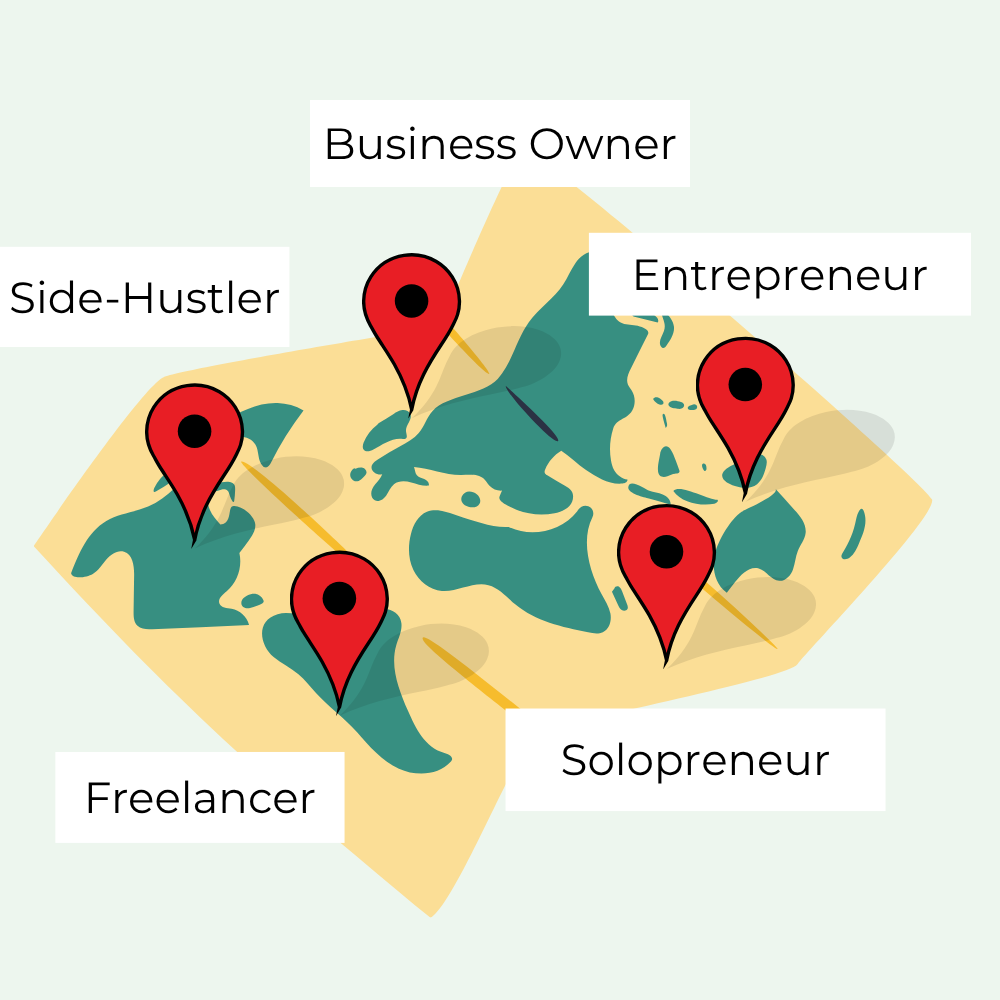
Side Hustlers
People who earn extra income outside their main job. Maybe you still work full-time, but you design websites on weekends or sell products online.
According to HustlersLibrary.com, a side hustle is: “any type of work or business you pursue in addition to your primary source of income. It allows flexible hours and control over rates, anything from freelance writing to selling crafts online.”
Freelancers
Self-employed professionals who deliver services to multiple clients, often on short-term contracts. Think of designers, writers, developers, consultants who trade expertise for flexibility and variety.
Who May Be Part of the Gig Economy (and transition toward something bigger)
If you’re thinking longer term, beyond the “project-to-project” hustle, you may fit into these broader categories.
Solopreneurs
A solopreneur runs a business entirely on their own. They don’t just deliver work, they also handle marketing, sales, customer service, systems. They’re building something lasting, even if they’re still a one-person team.
“A solopreneur is an individual building and running a business on their own without any employees. They handle every aspect of the business including delivering the work, marketing, and customer service” [8]
Entrepreneurs
Entrepreneurs see opportunities, build teams, scale solutions. They don’t just pick up the next project,they build a business that operates beyond them.
“An entrepreneur is someone who sees a business opportunity and takes action to realize their vision. They are typically innovative problem solvers and are not afraid to take risks to start new ventures and create wealth. While there are no strict rules around the qualities of an entrepreneur, they are usually associated with developing new products or innovations.”[9]
Who Isn’t Part of the Gig Economy?
- Traditional Employees: People with medium- or long-term contracts, working for a single employer with less independence. They lack the flexibility and non-traditional structure that define the gig economy.
- Established Business Owners (scaling beyond freelancer/solopreneur): While they may have independence, their goal is stability and growth—so they’re somewhat outside the “gig” framing.
Making the Most of the Gig Economy: Practical Steps
If you’re intrigued by this route, here are actionable ways to navigate and optimize your path in the gig economy.
Step 1 – Clarify your goals.
What do you want from this working-style? Is it a side income for now, a flexible full-time alternative, or the start of a business? Having that clarity helps shape how you behave.
Step 2 – Pick a skill and build credibility.
Figure out what you’re offering. Ideally, it’s something you already know how to do but if it’s not find a way to learn it. Build a physical (meet local business owners, attend events and conferences, reach out to friends and acquaintances) and digital presence (LinkedIn, personal website, platform profile). Gather experience and build a network. Over time, you’ll become known for more than just “any freelance work.”
Step 3 – Diversify clients and income streams.
Relying on one client is risky. Figure out your capacity and ways to improve it. If possible, aim for more than one client or combine project-work with perhaps a subscription or retainer model. That builds stability.
Step 4 – Invest in systems and skills.
As you grow, the “business” part becomes important: invoices, contracts, tax budget, marketing, CRM. Learn simple business basics and figure out how to handle them. From virtual assistants to accounting software, today it is cheaper than ever to outsource administrative work.
Step 5 – Manage the downside.
Freelancing or any gig-based works requires organization. Budgeting, setting an emergency fund and separating personal and business expenses becomes relevant.
You may be interested in MML post: Freelance Money Management: 7 Steps to Stress-Free Finances
Step 6 – Think long term.
If you like independence and flexibility, consider how you might evolve: Could you scale by hiring someone? Build a product? Create recurring revenue (e.g., online course, membership)?
Even if your goal is simply flexible income, it’s useful to think 3-5 years ahead: Where will you be? What do you want your work-life to look like?
Real-World Anecdotes & Trends
Trend 1:
Younger workers are leading the charge. Many in Gen Z and Millennials prefer project-based, flexible work over traditional careers.[10]
Trend 2:
Remote, online gig work has made global talent a reality: you can live in Europe and work for a client in the US, for example.
Trend 3:
Growth in developing countries is especially rapid, digital gig work opens new markets for women and youth who may have lacked opportunities in formal employment. [11]
Trend 4:
Conversion of gigs into businesses, many freelancers often evolve into solopreneurs or entrepreneurs once systems and clients are established (even unconsciously).[12]

Red-Flags & Things to Watch
While the gig economy offers opportunity, it’s not without challenges, for instance:
- Low barriers to entry mean high competition. Without differentiation, it’s easy to end up racing to the bottom on price.
- The “always-on” mindset, when you’re your own boss, you might feel you always need to hustle. But that can lead to burnout.
- Lesser access to traditional protections (benefits, paid leave, maternity/paternity rights), many gig workers are responsible for their own safety nets.
- Client concentration risk, if one big client leaves, it can dramatically impact your income.[13]
- Difficulty separating personal and business life: from time to finances, you may find yourself having trouble differentiating where work ends and life begins.
How to Decide Where You Fit (and What’s Next)
Ask yourself:
- Do I still have a primary job or am I fully independent?
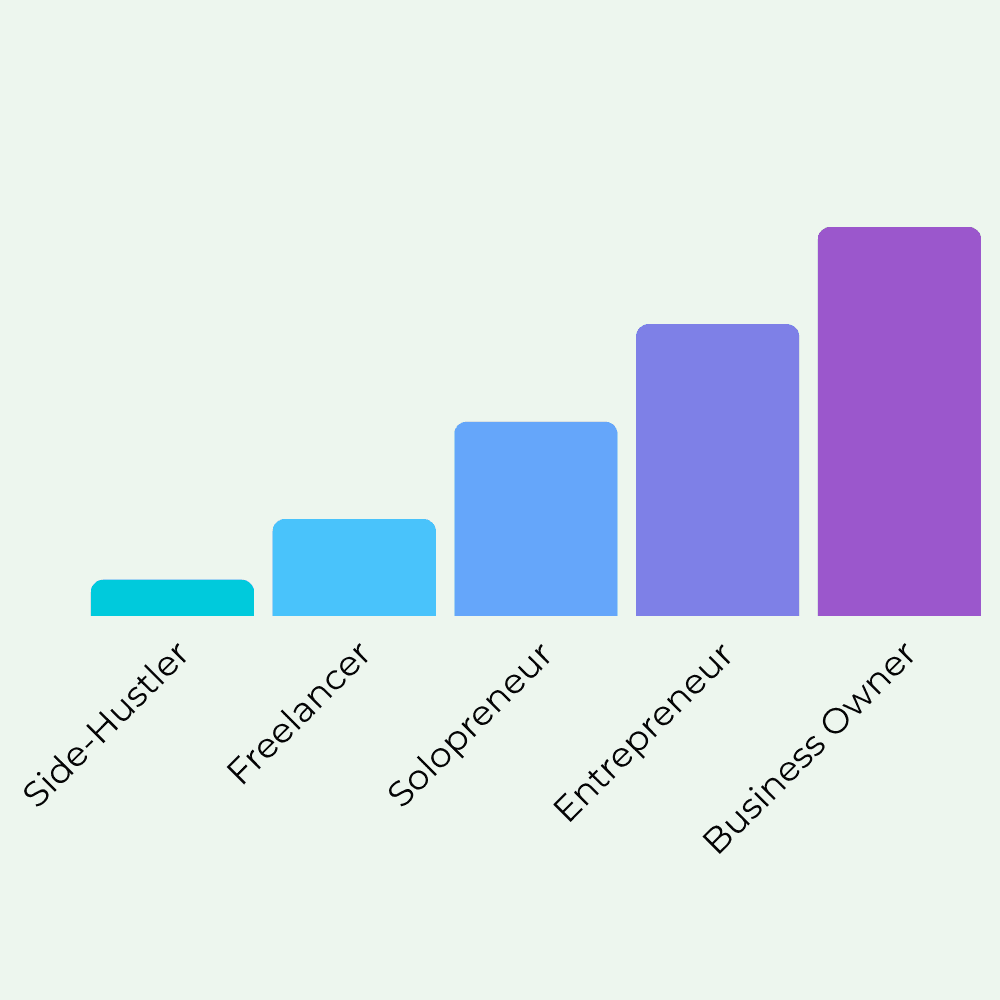
If you have a full-time job and you do separate projects on the side; you’re likely a side-hustler. - Am I delivering different projects for many clients without long-term commitments?
That’s more freelancer territory. - Do I think of my work as a business and invest in systems, marketing, recurring revenue?
That moves toward solopreneur. - Do I see building a team, product, and scaling beyond myself?
That’s entrepreneur realm. - Do I own or manage a business with employees and independence from being the “doer”?
That’s business owner territory, outside the core “gig economy” definition but definitely a logical next step.
By distinguishing where you are (and where you’d like to be), you can tailor your actions accordingly: skill-up, invest in systems, or diversify income.
The Takeaway: Independence Is a Journey
The gig economy isn’t a fad, it’s an evolution made more accessible by current technology. For many, it’s a bridge between traditional employment and long-term business ownership. While it brings uncertainty, it also opens doors to freedom, creativity and control over your time, opportunities and finances.
Whether you’re freelancing after hours or dreaming of launching your own venture, remember: every “gig” is a step toward building the independent life you want, you just need to make a learning experience out of it. Invest in yourself and give yourself time to learn all necessary skills. And let flexibility support you, rather than you constantly chasing work.
You’re not just doing random “jobs”, you’re choosing learning opportunities to deliberately shape your future.
[1] https://dictionary.cambridge.org/dictionary/english/gig
[2] https://dictionary.cambridge.org/dictionary/english/gig
[3] https://www.weforum.org/stories/2024/11/what-gig-economy-workers/
[4]https://www.mckinsey.com/~/media/mckinsey/featured%20insights/mckinsey%20explainers/what%20is%20the%20gig%20economy/what-is-the-gig-economy.pdf
[5] https://www.ilo.org/sites/default/files/2025-06/ILO%20-%20Mini%20Guide_%28Digital%29_13jun.pdf
[6] https://www.weforum.org/stories/2025/06/the-gig-economy-ilo-labour-platforms/
[7] https://www.ilo.org/sites/default/files/2025-06/ILO%20-%20Mini%20Guide_%28Digital%29_13jun.pdf
[8] https://www.uschamber.com/co/start/startup/what-is-solopreneur
[9] https://www.business.hsbc.uk/en-gb/insights/starting-a-business/what-is-an-entrepreneur
[10] https://www.intuit.com/blog/innovative-thinking/the-side-hustle-generation/
[11] https://blogs.worldbank.org/en/voices/promise-and-peril-online-gig-work-developing-countries
[12] https://www.entrepreneur.com/starting-a-business/from-side-gig-to-6-figure-success-how-i-built-a/482133
[13] https://www.freelancing.support/flightplan/task/understand-the-risks/